
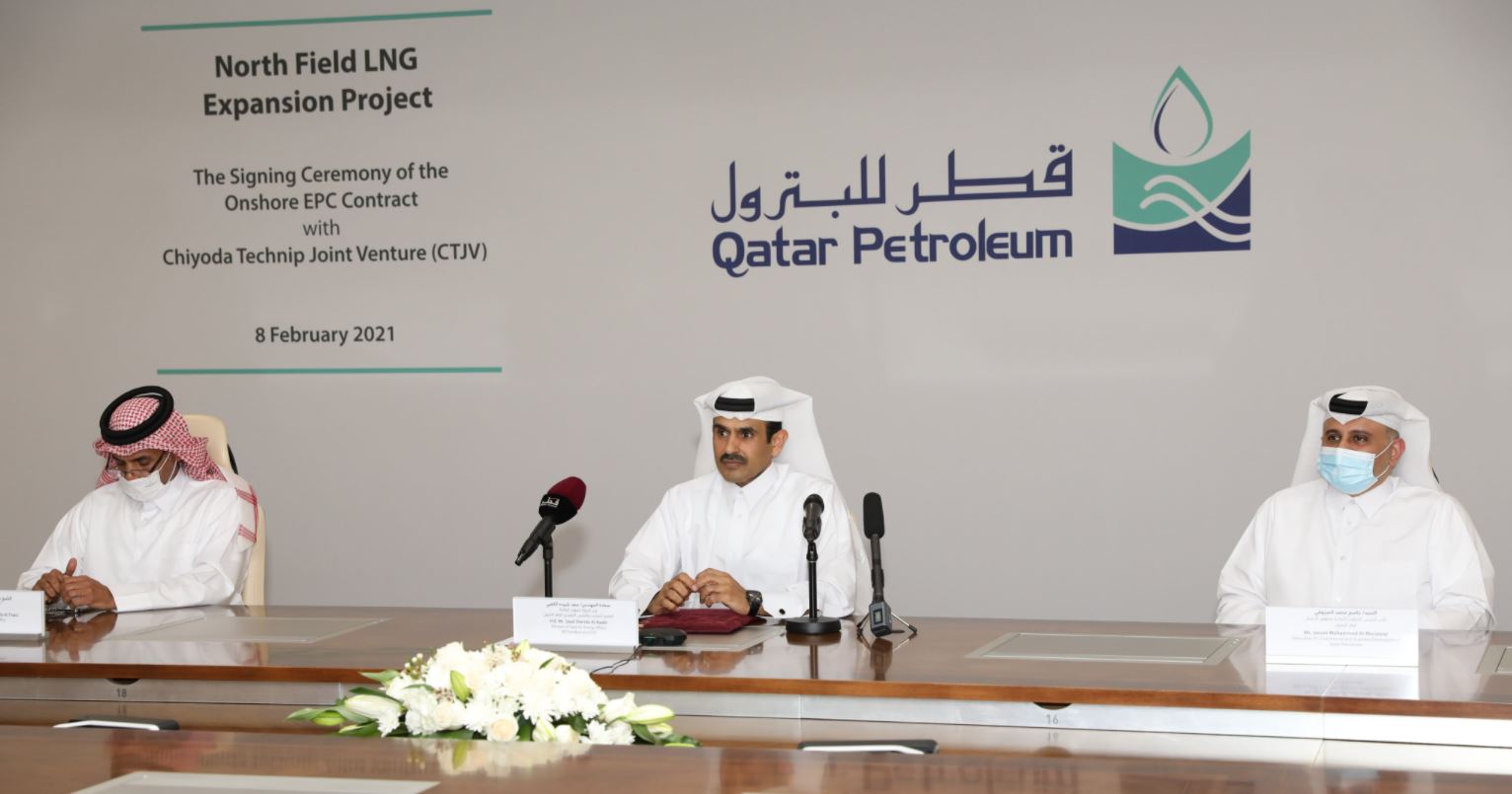
Qatar Petroleum said on Monday it awarded a key onshore engineering, procurement and construction contract to a joint venture consisting of Chiyoda and Technip for its giant LNG expansion project.
The EPC award is part of the North Field East project and includes building four “mega trains” with a capacity of 8 million tonnes per year in the Ras Laffan complex.
Furthermore, this first phase of the expansion project will increase Qatar’s LNG production capacity from 77 to 110 mtpa.
Moreover, this will allow the Gulf nation to take back its position as the world’s number one LNG producer.
QP’s unit Qatargas already operates six LNG trains at Ras Laffan.
In addition to LNG, the expansion project will produce condensate, LPG, ethane, sulfur and helium.
By awarding the contract, Qatar Petroleum also took a final investment decision on the expansion project.
Qatar Petroleum expects to start production in the fourth quarter of 2025. The project’s total production will reach about 1.4 million barrels oil equivalent per day.
Qatar’s energy minister and chief executive of QP, Saad Sherida Al-Kaabi said the execution of the contract marks the start of construction of the North Field East LNG project.
“The total cost of the NFE project will be 28.75 billion dollars, making it one of the energy industry’s largest investments in the past few years, in addition to being the largest LNG capacity addition ever, and the most competitive LNG project in the world,” Al-Kaabi said.
“This event is of particular importance as it comes at a critical time when the world is still reeling from the effects of a global pandemic and related depressed economies,” he said.
CCS and solar power
The new project comes with a CO2 capture and sequestration (CCS) system that will be integrated with QP’s wider CCS scheme in Ras Laffan.
Once operational, the CCS will be the largest of its kind in terms of capacity in the LNG industry, and will be one of the largest ever developed anywhere in the world, Al-Kaabi said.
In addition to the CCS scheme, the NFE project will get most of its power needs from Qatar’s national grid.
Qatar Petroleum says it is in the process of procuring such power from the 800 megawatt solar power plant currently under construction in Al-Kharsaah.
This is in addition to a further 800 megawatts of solar power which Qatar Petroleum will construct in the near future as part of its plans to have a solar power portfolio of more than 4,000 megawatts by 2030.
Largest single LNG project ever
Wood Mackenzie research director Giles Farrer said in a report following this announcement that the 33 mtpa development becomes the largest single LNG project sanctioned in history.
In addition, it could well also be the biggest project sanctioned across the global upstream business this year, he said.
“At a long-term breakeven price of just over $4 per million British thermal units, it’s right at the bottom of the global LNG cost curve, alongside Arctic Russian projects,” Farrer said.