
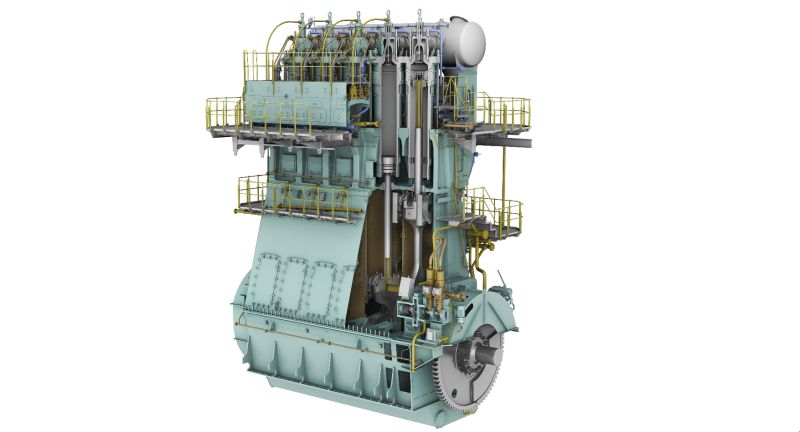
Switzerland-based Winterthur Gas & Diesel (WinGD) is adding four new versions to its best-selling dual-fuel engine as it looks to offer more flexibility to ship owners.
According to WinGD, besides being the best-selling engine in its portfolio, the X72DF accounted for every low-speed engine ordered for a newbuild LNG carrier in 2020.
In addition, the X72DF is also applicable on Suezmax tankers, Panamax and sub-Panamax containers and Capesize bulk carriers.
“These options reflect the varied demands on shipowners to design vessels more efficiently, reduce installed power and cut emissions dramatically. Whatever route shipowners choose to meet these demands, there is now an X72DF that will work for them,” said WinGD global sales director Volkmar Galke.
Alongside baseline design improvements to the platform, an option is now available to optimise lower power output in five and six-cylinder configurations. These new versions are also available with enhanced methane slip reducing X-DF2.0 technology, the firm said.
Four versions in detail
The engine maker said the base version, X72DF-1.1, incorporates the company’s new engine control architecture, WinGD Integrated Control Electronics (WiCE).
For five and six-cylinder engines, further optimisation is available to improve efficiency at lower power outputs. The X72DF-1.2 features a selected power/speed range with a lower specific fuel consumption, it said.
This configuration designed specifically for ships like LNG carriers will be attractive to owners and shipyards seeking to limit installed power in line with the IMO’s energy-efficient design indexes for newbuilds and existing vessels, WinGD said.
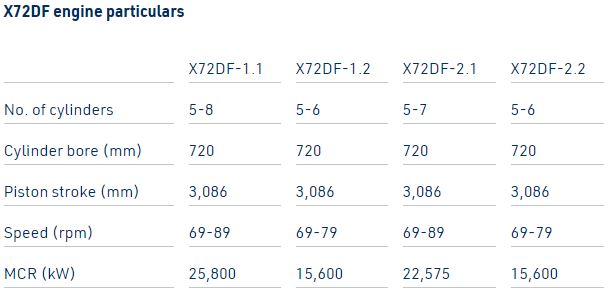
The option of reduced power rating and limited cylinder configuration enables a more compact design, with a shorter thrust section, an optimised gear drive and a smaller fuel supply unit contributing to reduced engine length, the firm said.
Moreover, the new versions are both available as X-DF2.0 upgrades featuring iCER (intelligent control by exhaust recycling) technology.
Released in June last year, iCER reduces methane emissions by up to 50% compared with X-DF1.0 engines. The X72DF-2.1 and 2.2 have been specifically tailored for all LNG-fueled vessels, the firm said.
With improved overall GHG emissions, reduced methane slip and lower gas consumption, the X72DF-2.0s are the “most competitive” solutions in terms of opex and overall emissions for LNG carriers, capesize bulkers, suezmax tankers and 3,000-8,000 TEU container ships, the firm said.
WinGD added all four versions are already available with the first delivery scheduled for April 2022.
Furthermore, the firm targets delivery of the first iCER-equipped version in the third quarter of the same year.
Worth mentioning here, Japan’s shipping giant NYK said its recently ordered LNG-powered PCTC quartet will feature the WinGD X-DF2.0 iCER main engine.