
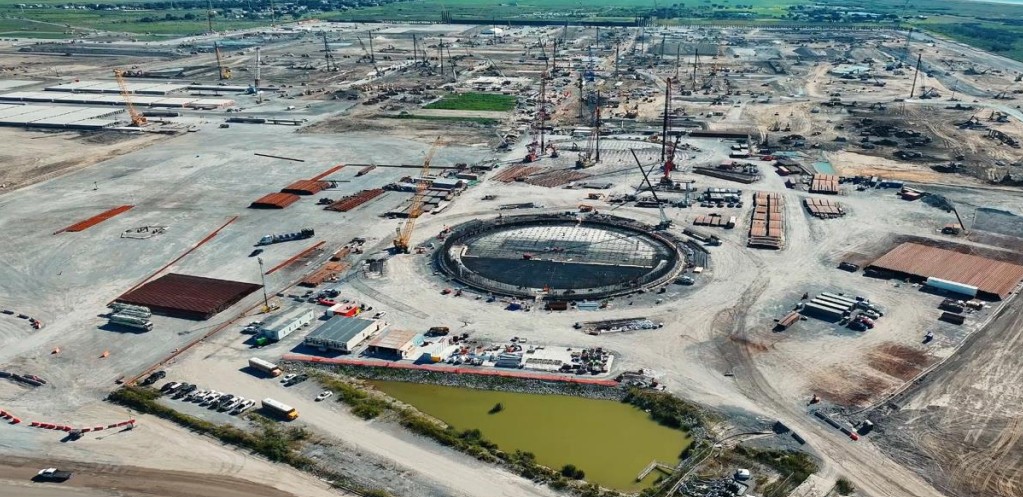
In July, Venture Global took FID on the first phase of its CP2 LNG project with a nameplate capacity of 14.4 mtpa. First LNG from this phase is expected in late 2027.
The company also closed the $15.1 billion project financing, claiming that it represents the largest standalone project financing ever, and the second-largest project financing after the combined financings of Venture Global’s Plaquemines LNG.
The CP2 LNG plant site is situated adjacent to Venture Global’s existing Calcasieu Pass liquefaction plant in Louisiana, which commenced commercial operations in April.
Venture Global previously stated that the peak run-rate production level of Phase 1 is expected to be approximately 20 mtpa, while Phase 2 has a nameplate capacity of 5.6 mtpa with an expected peak production capacity of about 8 mtpa.
SPAs
Sabel said on Monday during Venture Global’s third-quarter earnings call that the new SPAs the firm signed with Spanish utility Naturgy and a newly formed joint venture of Greek companies Aktor and DEPA are for volumes from the second CP2 phase.
“Including the three offtake commitments we previously announced and signed in July, Venture Global has now added 5.25 mtpa of new 20-year SPAs in the second half of 2025, which I think might be the most in the market globally. I expect more to follow,” Sabel said.
He said that Venture Global continues to “build momentum towards FID for CP2 Phase 2.”
“We continue to have constructive conversations with offtakers and aim to sign additional SPAs before the end of the year,” he said.
“As I’ve said before, given the lower cost per ton of brownfield expansion and our significant equity already invested in Phase 2 of the project, which is now over $1 billion, we do not anticipate needing many more 20-year SPAs to reach FID for either Phase 2 or even beyond that, Phase 3,” Sabel said
He said this contract strategy is supportive of Venture Global maintaining a balanced portfolio of intermediate, short, and long-term contracts.
“The targeted FID timeframe for phase two remains the first half of 2026,” Sabel said.
Up to $29.5 billion
Venture Global expects a total project cost of $28.5 billion to $29.5 billion, including both CP2 LNG phases.
Sabel noted that the “key to success in any commodity business is being the low-cost producer, which for CP2 Phases 1 and 2 should be just above $1,000 a ton all in, including our inside-defense power plants, the pipelines, owner’s costs, and all other construction costs.”
“Additionally, we generate considerable cash flow during construction and commissioning, which we view as an offset to project cost,” he said.
“In this case, based on the forward Henry Hub and TTF curves, for CP2, we estimate these construction and commissioning pre-COD cargo sale Ebitda proceeds would yield an estimated $8 billion of cash flow during construction, reducing CP2’s net cost down to approximately $21 billion,” Sabel said.
Following COD, cash flows will come from a combination of fixed liquefaction charges under Venture Global’s long-term SPAs and contractor pricing on available capacity in excess of that sold under the company’s 20-year long-term contracts, he said.
“In the case of CP2 Phases 1 and 2, we expect this available excess production to be 9-11 million tonnes, which we anticipate selling on a medium and short-term basis or a non-20-year basis,” he said.
30 mtpa
Sabel also discussed Venture Global’s data science operations, which helped boost Plaqumines LNG capacity and are expected to add to the CP2 capacity.
“We’ve always viewed our facilities not as factories, but as complex machines that to us always create opportunity for acquisition of data and analysis of that data. I think for Calcasieu Pass, we’re streaming now around 222,000 data points every 10 seconds. It’s a massive amount of data,” he said.
He said Plaquemines would exceed that volume of data throughput.
“We have a dedicated team of data scientists and process engineers and AI programmers that have been incorporating that data into our current operations, but also into design changes as we’ve learned some very surprising interactions of different parts of the facility that are unanticipated that have contributed to our ability to achieve the remarkable performance results at Plaquemines and that we expect will carry over into CP2,” he said.
“It has been an incredible effort for us, and we’ve been hugely rewarded in the volume of production that we’ve achieved and maintained,” he said.
“Just to add to that, we think that that will allow us to push CP2 up to 30 mtpa,” he said.
“We’ll have to go back and get the export authorization moved from 28 up to 30, but we think CP2 will be doing even better than Plaquemines, which is doing the best that any project has ever done,” Sabel added.