
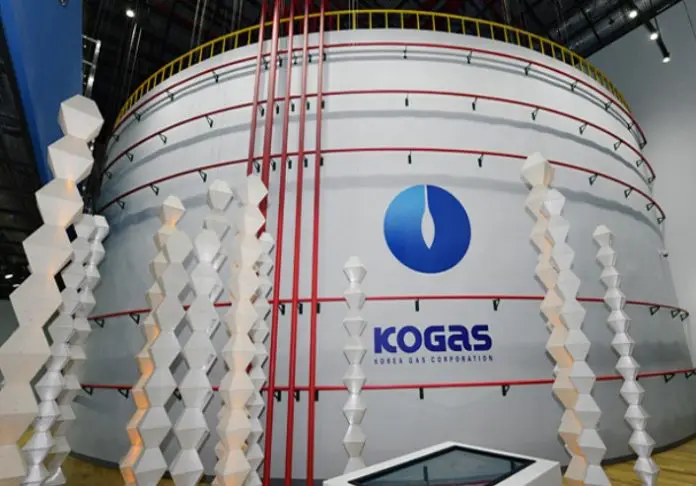
State-owned Kogas sold 3.02 million mt last month, compared to 2.67 million mt in November 2024, the firm said in a stock exchange filing.
November sales were 33 percent higher compared to the previous month’s 2.27 million mt, which marked a rise of 6.1 percent on the year.
Purchases by power firms increased 19.7 percent year-on-year to 1.30 million mt in November and were higher by 10.1 percent compared to the previous month.
Moreover, Kogas said its city gas sales rose 8.3 percent year-on-year to 1.71 million mt in November. City gas sales were 58.1 percent higher compared to the previous month.
Kogas said in its quarterly report last month that it had sold 25.35 million mt in the first nine months of this year, almost flat compared to the previous year.
The company sold 18.89 million mt in the first half of this year, up by 3.7 percent compared to the same period last year.
Kogas said its city gas sales rose by 3.9 percent as demand for civil use increased due to a sharp drop in temperature in February and April compared to previous years.
The firm also said that demand for industrial and fuel cell use increased, leading to higher sales volume.
According to Kogas, power firm purchases decreased 4.2 percent due to economic downturn and a reduction in peak power generation following an increase in base-load generation.
Korean LNG imports
Kogas operates 77 LNG storage tanks at five LNG import terminals in South Korea.
The large terminals include Incheon, Pyeongtaek, Tongyeong, and Samcheok, while the firm has a small-scale regasification terminal at the Aewol port on Jeju island as well.
In addition to these facilities, the firm is building a large terminal in the western port city of Dangjin.
Kogas expects to complete the first phase of the Dangjin LNG terminal in May 2027 and the second phase in December 2029, according to its quarterly report.
The company previously expected to complete the second phase in October 2028.
Official statistics for South Korean LNG imports in November are not yet available.
According to customs data, South Korean LNG terminals received 38.44 million mt of LNG during the first ten months of this year, a rise compared to 38.03 million mt in 2024.
Australia was the biggest supplier to South Korea during the period, with 12.18 million mt of LNG, followed by Malaysia with 5.92 million mt, and Qatar with 5.76 million mt, the data shows.