
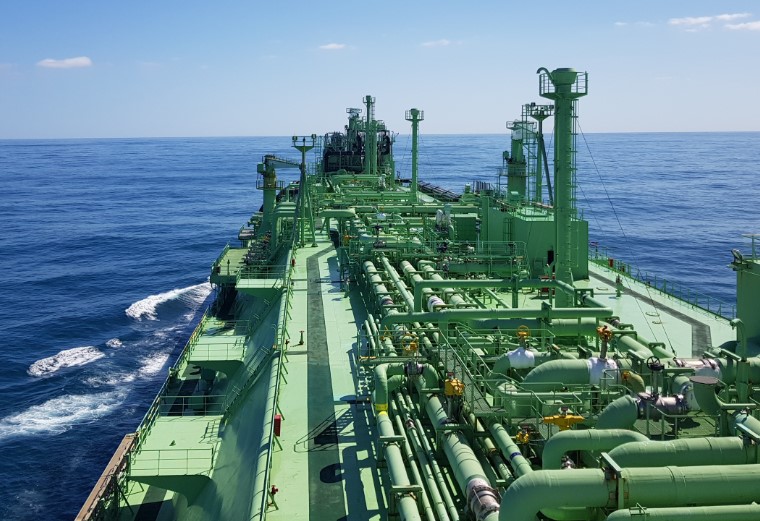
Sources said BW is the first shipowner to opt for the three-tank design over the standard four-tank LNG carrier.
There are no LNG carriers with a capacity of 80,000 cbm or more with fewer than four cargo tanks, they said.
BW LNG, a unit of Singapore-based gas shipping giant BW, recently confirmed that it has placed an order for two LNG carriers at South Korea’s HD Hyundai Samho.
The order is valued at approximately $508 million, and it appears that BW LNG ordered the vessels without a tied charter agreement.
The Oslo-based LNG carrier operator said that the LNG newbuildings are scheduled for delivery in the early fourth quarter of 2028.
Both vessels will be equipped with XDF 2.2 propulsion with VCR, shaft generators, and a full reliquefaction system.
The vessels also have “some interesting technical options which we will look to develop further with clients,” BW LNG said.
According to BW LNG’s website, the two new vessels (H8340 and H8341) will each have a capacity of 177,000 cbm, and not 174,000 cbm.
LNG Prime invited BW to comment on the vessels’ capacity and the three-tank design, but we did not receive a response by the time this article was published.
Three-tank designs
French LNG containment giant GTT also said in a statement on December 3 that it has received an order from HD Hyundai Samho’s parent HD Korea Shipbuilding & Offshore Engineering (HD KSOE) for the tank design of two new LNG carriers, which will be built for BW LNG.
GTT said the vessels’ cryogenic tanks will be fitted with the Mark III Flex membrane containment system, but it did not provide further details regarding the tanks.
In 2022, GTT received approvals from DNV and BV for its three-tank LNG tanker design aimed at increasing the profitability and overall performance of vessels.
GTT says that this three-tank LNG carrier concept permits a reduction in construction costs through the suppression of one cofferdam, one pump tower, and all associated cryogenic equipment such as liquid and gas domes, valves, piping, radars, etc.
Also, the overall surface area of the containment system would be reduced by about 2,000 cbm, generating lower costs for the materials and vessel construction, the Paris-based firm said at the time.
In addition to this design, GTT also secured approval from Lloyd’s Register for its three-tank LNG carrier with a capacity of 200,000 cbm last year.
LR and GTT said the 200,000-cbm LNG carrier design offers “significant” environmental and economic advantages.