
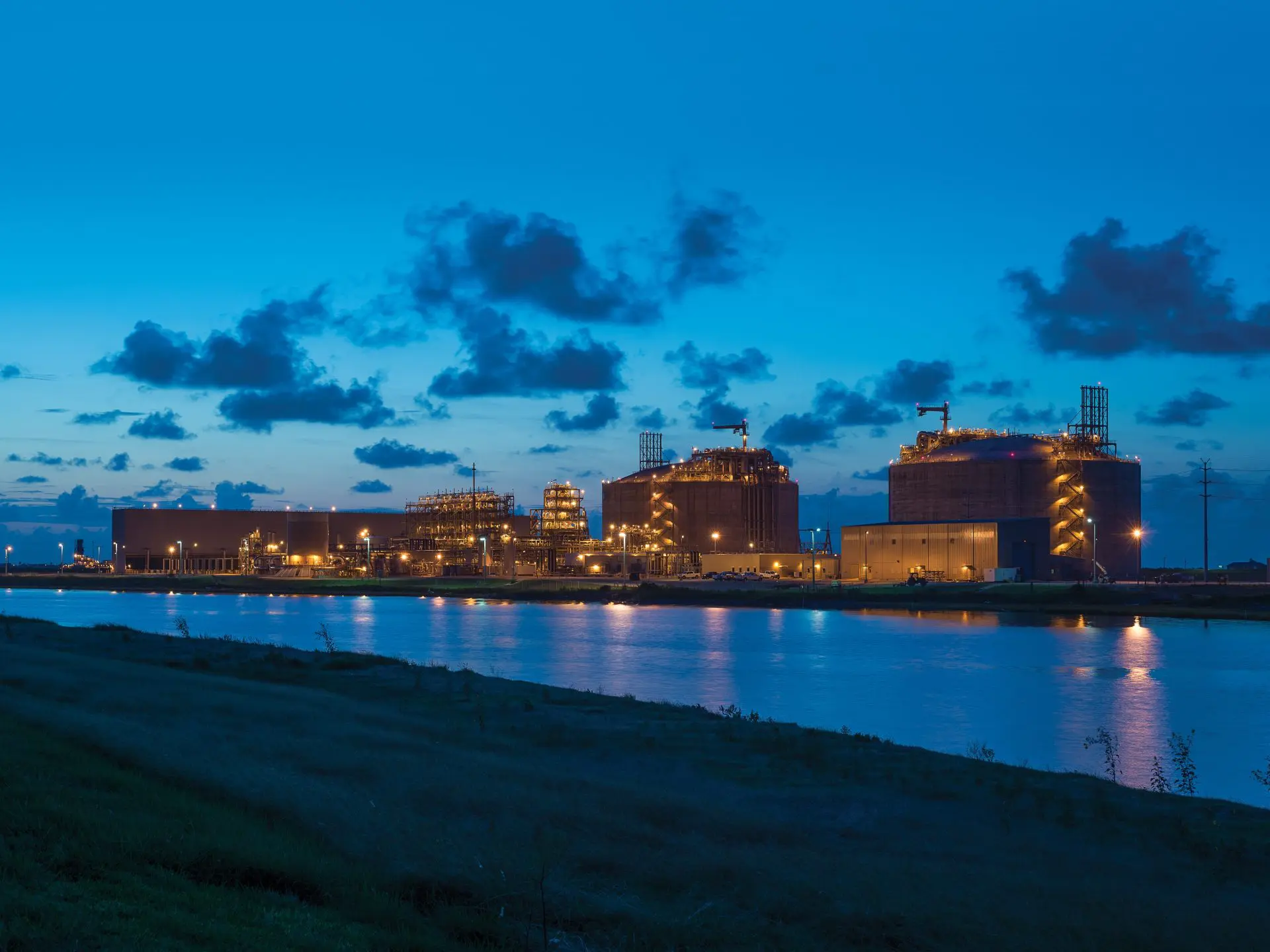
Upon completion of the Freeport LNG facility in June 2008, it featured two 160,000-cbm LNG storage tanks, a marine dock capable of accommodating the largest LNG tankers in service, and an LNG vaporization system capable of delivering over 2 billion cubic feet (Bcf) of gas per day into the domestic pipeline grid.
However, by the time the import terminal commenced operations, the North American natural gas industry had begun to experience the shale gas revolution.
The terminal received its last import cargo in February 2011.
Shortly thereafter, Freeport LNG filed applications with FERC to modify the previously authorized facilities, including elimination of the additional vaporization equipment, which had not yet been constructed, and for authorization to site, construct, and operate natural gas liquefaction and export facilities at and adjacent to the terminal.
Freeport LNG’s liquefaction Train 1 began commercial operations in December 2019, with Train 2 and Train 3 commencing operations in January and May 2020, respectively.
Today, Freeport LNG export facilities include three liquefaction trains, three LNG storage tanks, two marine berths, and associated piping.
Demolition
As the terminal has been operated exclusively for the purpose of liquefying natural gas and exporting LNG, and has not regasified imported LNG for well over a decade, Freeport LNG proposes to decommission, disconnect, and/or demolish certain obsolete facilities authorized in the import order, which are no longer necessary for the terminal’s present-day operations, Freeport LNG told FERC on April 6.
According to Freeport LNG, underground piping, equipment foundations, and concrete paving
associated with these facilities will also be demolished as part of the project.
Notably, certain facilities approved by the import order will remain in service to support Freeport LNG’s ongoing export operations at the terminal.
Accordingly, Freeport LNG is not seeking to terminate the NGA authorization with respect to all facilities authorized by the import order.
“In this regard, Freeport LNG requests that the Commission terminate the import order, in part, with respect to the regas facilities listed in Appendix A.1,” it said.
“Removal of the regas facilities will enhance the safe operation of the terminal as, among other things, it will significantly reduce the time Freeport LNG employees spend on maintenance and inspection of non-operational assets, and allow employees to instead focus on the safe maintenance and operation of those facilities currently in use,” Freeport LNG said.
Freeport LNG requests that the Commission issue an order terminating the authorization by no later than December 31, 2026.
Three phases
Freeport LNG proposes to execute the project in three phases.
Under the first phase, Freeport LNG will conduct a detailed engineering design effort to
develop the methodology and associated documentation to support the safe and efficient
disconnection, decommissioning, and demolition of the regas facilities, while ensuring the safe
continued operation of systems that must remain in service.
“Under the second phase, Freeport LNG will develop specific procedures for the disconnection of the regas facilities from the terminal’s liquefaction facilities, as well as the relocation and/or minor modification of the facilities listed in Appendix A.2,” the company said.
The third and final phase involves the demolition of the regas facilities, including the removal of all logic in Freeport LNG’s distributed control system (DCS) related to the regas facilities, and the physical removal of applicable equipment, piping, components, and structural steel.
Underground piping, equipment foundations, and concrete paving associated with the facilities to be removed will also be demolished and removed from the site, Freeport LNG added.
LNG export plant
Last year, Freeport LNG shipped the 1,000th cargo of LNG since 2029.
In addition, the LNG terminal operator completed its debottlenecking project, which increased the terminal’s production capacity from an excess of 15 mtpa to just over 16.5 mtpa.
Freeport is also planning to add a fourth liquefaction train to boost its capacity by 25 percent.
In July last year, Freeport secured an additional extension from the US Federal Energy Regulatory Commission (FERC) to construct the fourth liquefaction train.
In 2024, Japan’s Jera agreed to sell a part of its stake in Freeport LNG to compatriot Japan Petroleum Exploration (Japex).
Besides the Jera stake, Osaka Gas has a 10.8 percent stake in Freeport LNG while Freeport LNG Investments holds a 63.5 percent stake.