
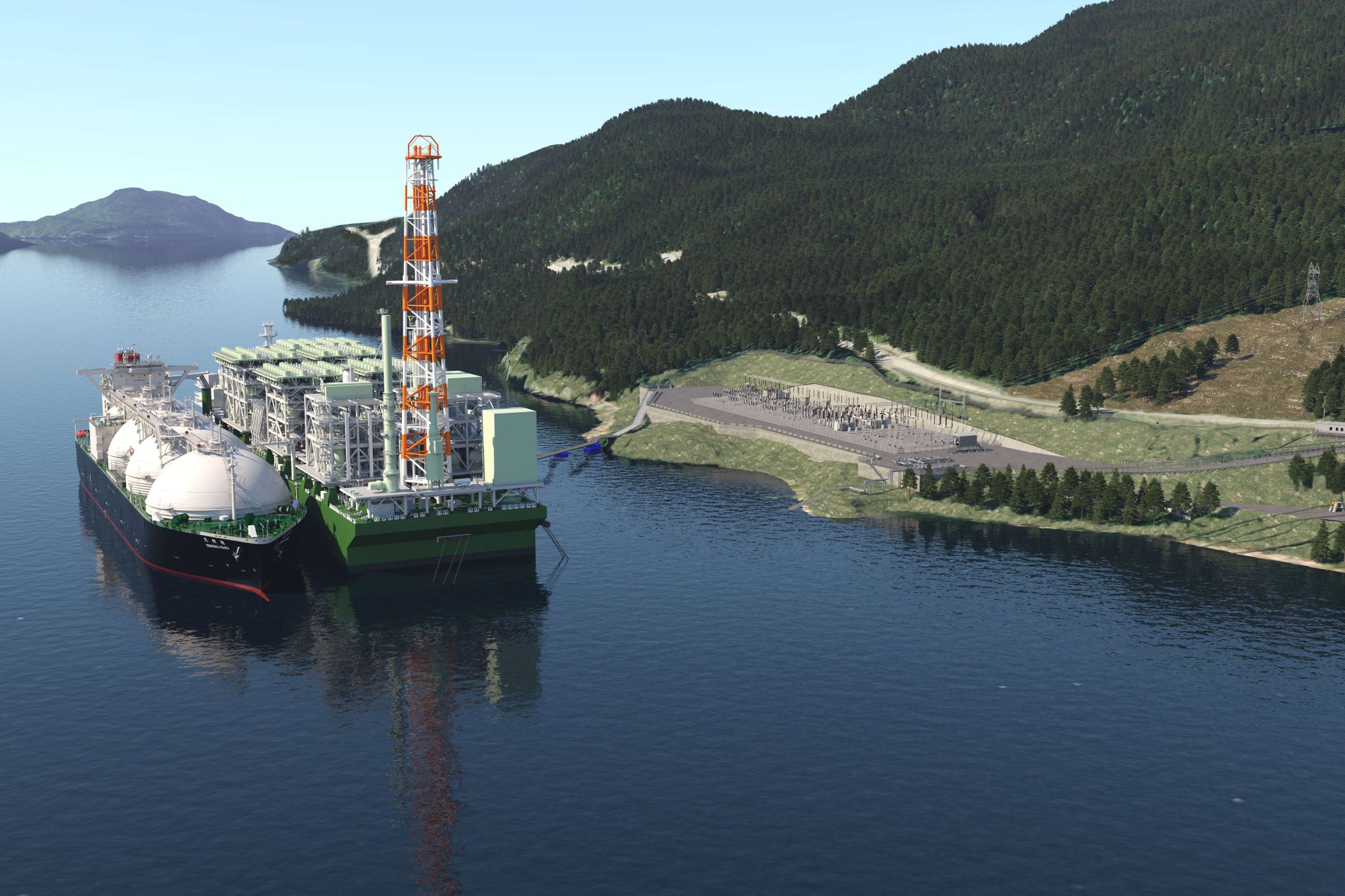
British Columbia’s Environmental Assessment Office (EAO) said in a note last week that it has received an application from Cedar LNG Partners (GP) to make changes to its plans for the Cedar LNG project, a floating liquefied natural gas facility and marine export terminal in Kitimat.
According to the EAO, the company proposes to increase the facility’s liquification capacity from 400 to 500 million standard cubic feet per day of natural gas and to house up to 80 workers at the facility.
These proposed changes require an amendment to the previously approved environmental assessment certificate issued by the EAO in 2023.
The certificate was necessary for the project to proceed and any changes to the project must be approved by the EAO.
“The EAO will engage with First Nations, the technical advisory committee and the public to determine whether the application contains enough information to conduct an assessment of the potential impacts of the project. A public comment period will be announced soon,” it said.
Operational efficiencies
Cedar LNG said in its application submitted with the EAO that the increased capacity would be possible due to “operational efficiencies, and will not alter the approved works, nor will it change the number of LNG carriers visiting the project each year beyond the previously approved 50 carriers per year.”
The JV claims that greenhouse gas (GHG) emissions will be consistent with those already approved.
The increase in capacity is anticipated to result in an “increase in revenues to
Haisla Nation, the province of British Columbia, and the government of Canada,” it said.
Moreover, advancement of the development of the FLNG facility, including expert advice regarding the classification and regulation of FLNGs, has led to the determination that housing workers aboard the FLNG is “optimal from a health, safety, and operability perspective.”
Originally, Cedar LNG anticipated housing the majority of its workers within the local community.
Cedar is now proposing to house up to 80 workers on the FLNG to “maximize safety and efficient operations in accordance with international and national safety conventions.”
FLNG
In June, South Korea’s Samsung Heavy Industries officially started building Cedar’s FLNG, which will be installed in Kitimat.
Cedar LNG said that the Haisla Nation has chosen “megúgu” as the name for the floating LNG facility.
Once complete, the vessel will be transported from South Korea to the Cedar LNG site in Haisla traditional territory.
Cedar LNG said the FLNG is anticipated to be complete in 2028, prior to Cedar LNG’s estimated in-service date of late 2028.
In June 2024, Pembina and the Haisla Nation took the final investment decision on the $4 billion LNG project.
The Haisla Nation has a 50.1 percent stake and Pembina owns 49.9 percent in the project, which includes the construction of a floating LNG facility with a nameplate capacity of 3.3 million tonnes per annum (mtpa).
Cedar LNG issued a notice to proceed to Samsung Heavy and Black & Veatch for its FLNG following the finalization of long-term commercial offtake agreements.
Samsung Heavy is responsible for the hull of the FLNG and topside plant processes, while Black & Veatch will provide its PRICO technology.