
US energy services firm Baker Hughes and ST LNG announced the agreement in a statement on Monday.
As part of the agreement, Baker Hughes will provide two LM6000PF gas turbine-driven centrifugal compressor trains and three NovaL16 gas turbine generator packages, securing the necessary production capacity for the first phase of the project.
The first phase is expected to deliver 2.1 mtpa as part of a planned four-phase development.
Furthermore, the selection of Baker Hughes for this facility, to be located in US federal waters, represents a “significant” milestone as the project progresses toward a final investment decision, the statement said.
Baker Hughes said it expects to recognize orders associated with this agreement as the project advances.
“As we advance toward completion of the project’s first phase, selecting proven technology from a reliable partner with deep domain expertise is essential,” said ST LNG CEO Sharad Tak.
“Baker Hughes’ extensive experience across LNG projects, including complex offshore environments, provides confidence that the ST LNG facility will achieve first LNG in the second quarter of 2030,” Tak said.
Approvals
Last year, the Maritime Administration (MARAD) and the US Coast Guard (USCG) received an application from ST LNG for the proposed development.
In December, ST LNG filed an application with the US Department of Energy seeking approval to export LNG to FTA and non-FTA nations from its proposed project.
ST LNG is requesting long-term, multi-contract authorization from DOE to export LNG in an amount of up to approximately 460 billion cubic feet of natural gas per year (equivalent to approximately 8.4 million metric tons per annum) from its proposed deepwater port (DWP) export project.
The company said in the application that it could start loading LNG from the first phase of the project in 2029.
It also said in the application that it expects the launch of the second phase in March 2031, the third in September 2032, and the fourth in March 2034.
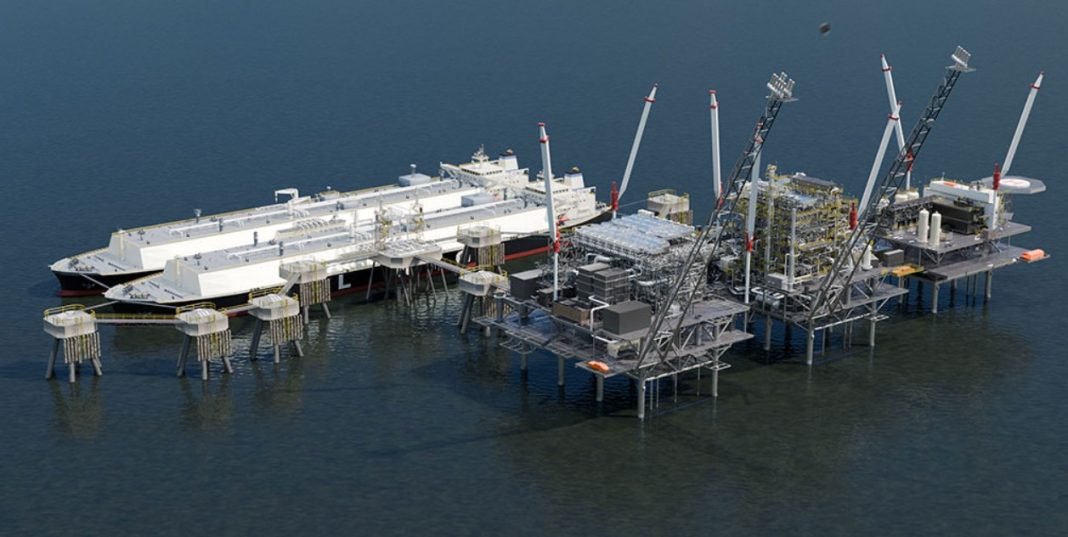
Each phase would include three large platforms (a gas treatment platform, an LNG liquefaction platform, and an accommodations and utility platform), one LNG transfer platform, and a dolphin mooring system.
The project would also include floating storage units (FSUs) for each of the phases.
ST LNG intends to acquire four existing LNG carriers and convert them to serve as FSUs.