
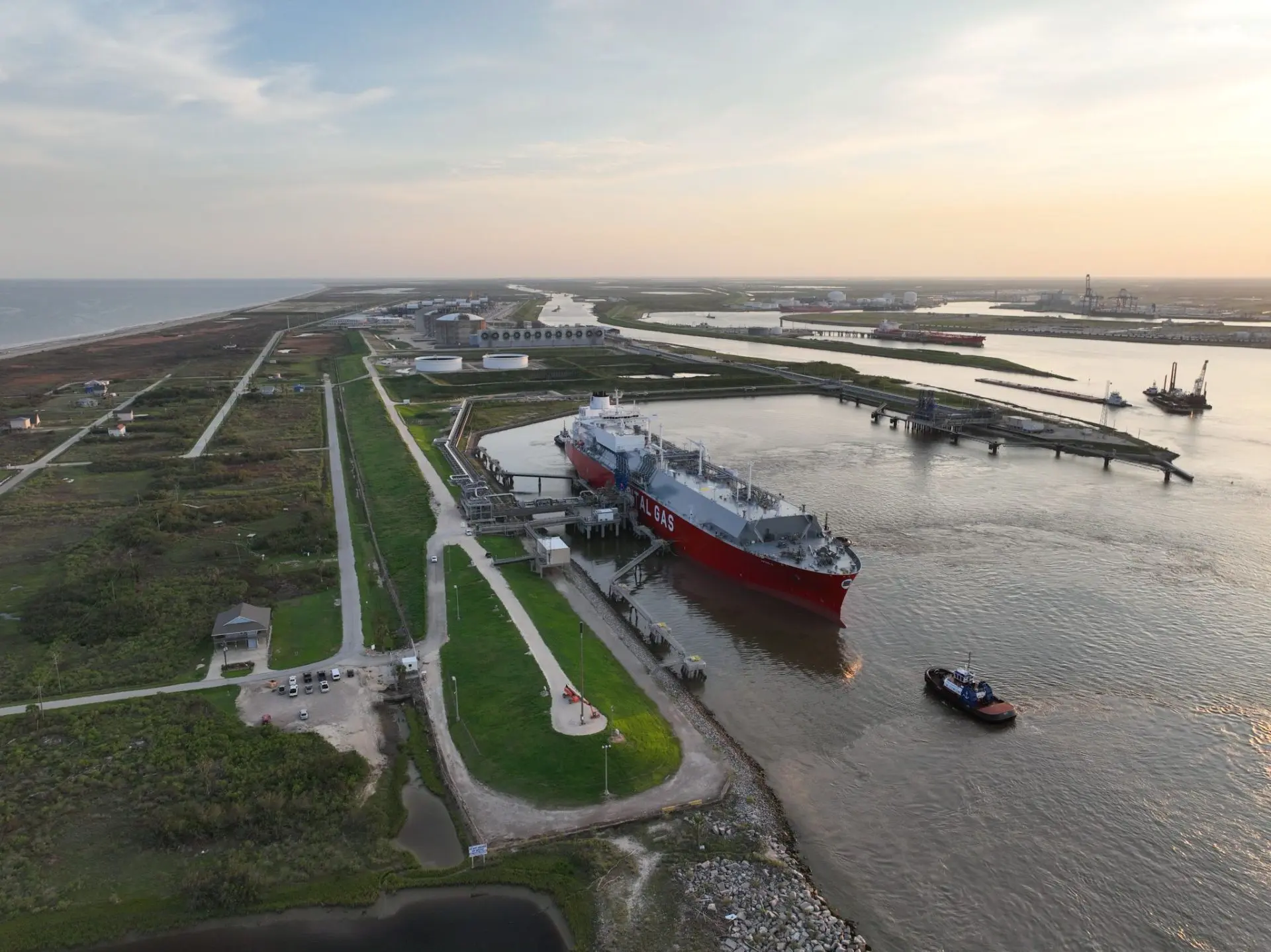
The agency said in its weekly report, citing shipping data provided by Bloomberg Finance, that the total capacity of these 25 LNG vessels is 94 Bcf.
This compares to 27 shipments and 102 Bcf in the week ending December 11.
Natural gas deliveries climb
According to data from S&P Global Commodity Insights, average natural gas deliveries to US LNG export terminals increased 0.1 Bcf/d from last week to 14.3 Bcf/d.
Natural gas deliveries to terminals in South Louisiana increased by 1.8 percent (0.1 Bcf/d) to 8.5 Bcf/d, while natural gas deliveries to terminals in South Texas decreased by 1.1 percent (0.1 Bcf/d) to 4.5 Bcf/d.
The agency said natural gas deliveries to terminals outside the Gulf Coast were unchanged at 1.2 Bcf/d.
During the week under review, Cheniere’s Sabine Pass plant shipped nine LNG cargoes, and the company’s Corpus Christi facility sent five shipments.
The Freeport LNG terminal and Sempra Infrastructure’s Cameron LNG terminal each sent four shipments, while Venture Global LNG’s Calcasieu Pass shipped two cargoes and the Cove Point terminal shipped one cargo.
The Elba Island facility did not export LNG between December 12 and December 18.
Plaquemines LNG
EIA noted that Venture Global announced on December 14 that it had reached first LNG production at its Plaquemines LNG plant in Port Sulphur, Louisiana, south of New Orleans.
Plaquemines LNG is Venture Global’s second LNG export facility on the US Gulf Coast.
Natural gas deliveries to the Plaquemines LNG export terminal are rising gradually after receiving approvals from the Federal Energy Regulatory Commission to begin introducing hazardous liquids to Plaquemines Blocks 1, 2, and 3, or 6 liquefaction trains (two trains per block), the agency said.
Pipeline deliveries on the Gator Express Pipeline serving the terminal, which receives gas from the Tennessee Gas Pipeline, averaged 0.2 Bcf/d this week, EIA said.
Henry Hub drops
According to the agency, the Henry Hub spot price fell nine cents from $3.11 per million British thermal units (MMBtu) last Wednesday to $3.02/MMBtu this Wednesday.
The price of the January 2025 NYMEX contract was essentially unchanged from $3.378/MMBtu last Wednesday to $3.374/MMBtu this Wednesday.
EIA said the price of the 12-month strip averaging January 2025 through December 2025 futures contracts declined 5 cents to $3.232/MMBtu.
TTF averaged $12.73/MMBtu
The agency said that international natural gas futures decreased this report week.
Bloomberg Finance reported that average front-month futures prices for LNG cargoes in East Asia decreased by $1.26/MMBtu to a weekly average of $13.78/MMBtu.
Natural gas futures for delivery at the Title Transfer Facility (TTF) in the Netherlands decreased $1.38/MMBtu to a weekly average of $12.73/MMBtu.
The agency said that in the same week last year (week ending December 20, 2023), the prices were $13.30/MMBtu in East Asia and $10.89/MMBtu at TTF.