
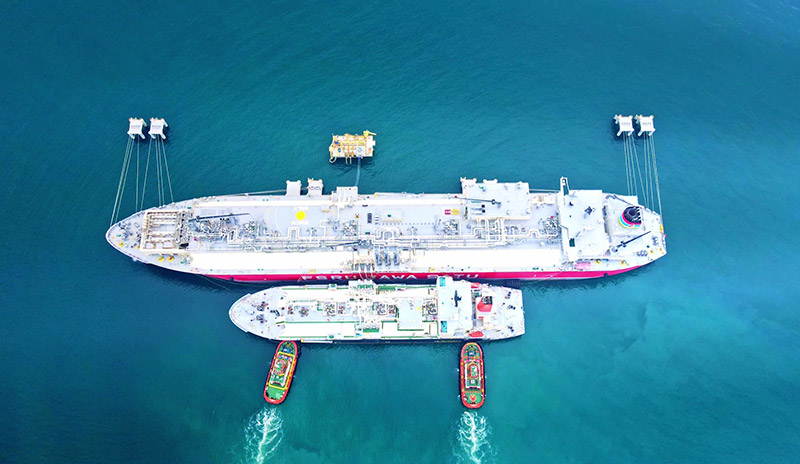
The Japanese shipping firm revealed this in its results report on Tuesday.
This is one more LNG carrier than in the previous quarter and five more LNG carriers than in the third quarter of 2024.
According to the new report, MOL expects its LNG carrier fleet to expand to 105 vessels by March 2026.
This is the same as in the previous forecast.
Earlier this year, brokers reported that MOL sold its 2004-built 137,500-cbm steam LNG carrier, Dukhan, for scrap.
MOL’s fleet includes LNG carriers owned and/or operated by joint venture companies.
Additionally, MOL previously stated that it had approximately 30 LNG carriers on order.
As of September 30, 2025, MOL’s fleet included eight FSUs/FSRUs, three LNG bunkering vessels, one LNG powership, and six ethane carriers.
As part of its plans to reduce emissions, MOL has also set a target to operate 90 LNG-powered and methanol-fueled vessels by 2030.
LNG earnings “stable”
MOL reported revenue of 869.7 billion yen in the quarter ended September 30, down 3.4 percent year-on-year, while operating profit of 71.8 billion yen dropped 19.6 percent year-on-year.
The company’s energy business, which includes the liquefied gas segment, reported revenue of 251.1 billion yen and profit of 47.7 billion yen, both up compared to the year before.
MOL said its LNG and ethane carrier business had “stable” earnings.
“In addition to stable earnings from long-term charter contracts, there were rescheduling of dry-docking for some vessels and one-time nonoperating income related to refinancing,” the company said.
For the gas infrastructure business, “profit was secured through stable operations of existing projects,” MOL said.
MOL also provided an outlook for the LNG and ethane business.
“Stable profit is expected to be secured by existing long-term charter contracts even though a decrease in profit is expected for certain projects due to delays in the delivery of new vessels,” the company said.
“Existing projects contribute to stable earnings while a decrease in revenue is expected due to equipment failure,” MOL said in relation to its gas infrastructure business.