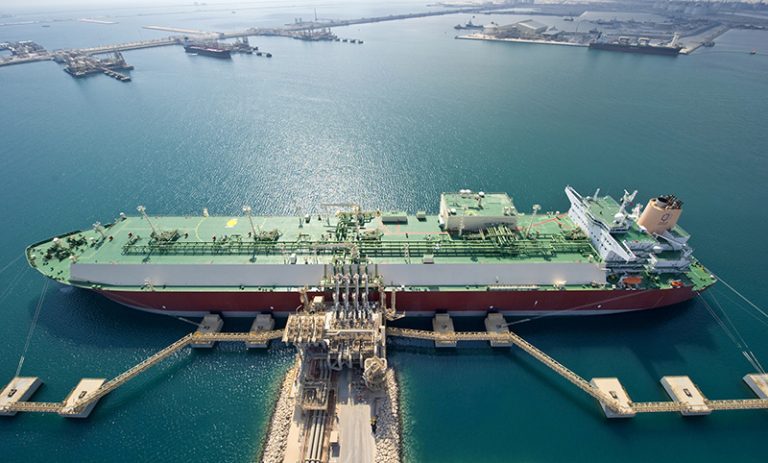
Sources told LNG Prime on Monday that Samsung Heavy and Hanwha Ocean are competing to win these orders.
The total number of vessels may reach 15 ships and the orders will probably be split by these two shipbuilders, the sources said.
They said the contracts could be signed in the next three months, while the first vessel in this new batch of Q-Max vessels is expected to be delivered in 2028.
According to the sources, the price tag for the giant vessels should be similar or slightly higher compared to the carriers QatarEnergy ordered in China.
QC-Max and charter deals
In April, QatarEnergy signed a major shipbuilding deal worth $6 billion with China State Shipbuilding Corp, the parent of Hudong-Zhonghua, for the construction of 18 271,000-cbm QC-Max LNG carriers.
This puts the price tag for each vessel at about $333 million.
Each of the LNG vessels will be 344 meters long, 53.6 meters wide, and will have a draft of 12 meters.
Also, the vessels feature WinGD dual-fuel propulsion, a reliquefaction system, an air lubrication system, and GTT’s NO96 Super+ containment tech. The vessels have five storage tanks.
Besides the shipbuiding deal, QatarEnergy signed long-term time charter party (TCP) agreements with four ship owners for the operation of the QC-Max vessels.
Nine of these vessels will be operated by affiliates of China Merchants Group, Shandong Marine Group, and China LNG Shipping.
CMES will operate four vessels, Shandong Marine Energy three, and CLNG two.
QatarEnergy also signed a time charter and operation agreement with compatriot shipping firm Nakilat for nine 271,000-cbm LNG carriers.
Currently, the world’s largest LNG carriers are Qatar’s Q-Max vessels that are about 345 meters long and have a capacity of 263,000-266,000 cbm.
Qatar’s Nakilat owns 14 Q-Max LNG carriers built by Hanwha Ocean (DSME) and Samsung Heavy between 2008 and 2010, and they all transport LNG from the giant Ras Laffan LNG complex in Qatar to customers around the globe.
122 vessels
Including the QC-Max LNG carriers, QatarEnergy’s massive shipbuilding program includes the construction of 122 vessels.
In March, QatarEnergy said it has completed the conventional sizes vessels portion of the shipbuilding program, bringing the total number of ships for which it signed time charter parties to 104 vessels.
South Korean yards and Hudong-Zhonghua will construct these 104 vessels.
Under the program, HD Hyundai Heavy Industries will build 34 174,000-cbm LNG carriers, Samsung Heavy will build 33 vessels, Hanwha Ocean will build 25 vessels, and Hudong-Zhonghua will construct 12 ships.
As per owners of the 174,000-cbm carriers, Nakilat will own 25 ships, a joint venture between H-Line Shipping, SK Shipping, and PanOcean 15 vessels, while J.P. Morgan’s Global Meridian will own 14 ships.
Moreover, a JV between NYK Line, K Line, MISC, and China LNG shipping will own 12 vessels, Knutsen 10 vessels, a JV between MOL and Cosco Energy 7 vessels, CMES and Shandong Marine will each own 6 vessels, a JV between K Line and Hyundai Glovis 4 vessels, MISC 3 vessels, and TMS Cardiff Gas 2 vessels.
The vessels will cater for QatarEnergy’s future requirements, as it moves forward with the expansion of its LNG production capacity from the North Field to 142 million tons per annum by 2030.
In February this year, QatarEnergy also announced the North Field West project which will add 16 mtpa of LNG to the overall expansion of the North Field.