
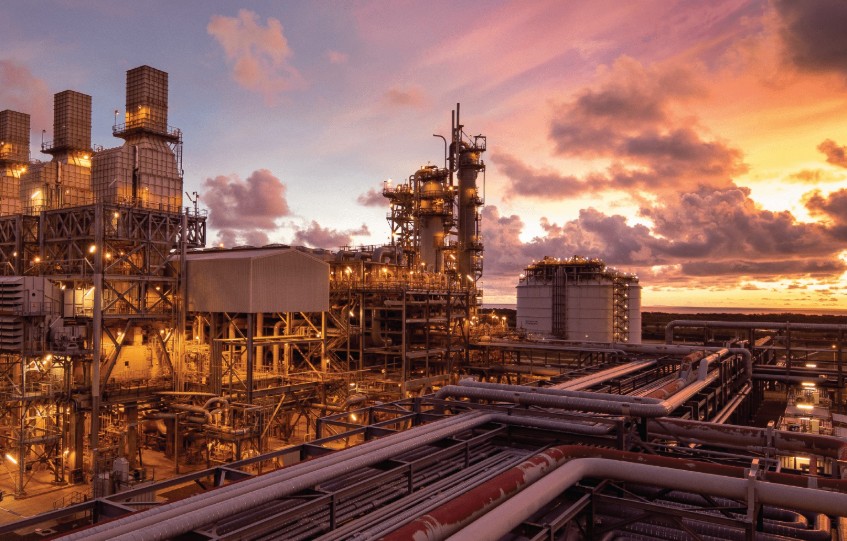
ExxonMobil holds a 33.2 percent operating interest in PNG LNG, while Santos has a 39.9 percent stake following the completion of a 2.6 percent stake sale to Papua New Guinea’s national oil and gas company Kumul, which now owns a 19.4 percent stake.
Other partners in PNG LNG include Mineral Resources Development Company and JX Nippon.
Santos said in its quarterly report last week that PNG LNG “maintained steady production at full plant capacity during the quarter supported by strong Angore production since coming online.”
PNG LNG produced about 2.11 million tonnes in the first quarter, up from 2 million tonnes in the same quarter last year and from 2.10 million tonnes in the previous quarter.
Santos said there were four spot LNG cargoes sold in PNG in the first quarter of 2025.
The firm also noted that Papua LNG has taken an “important” step forward” with the Conservation and Environment Protection Authority (CEPA) approving the downstream environment permit.
“TotalEnergies, operator of the Papua LNG project, continues to focus on advancing critical workstreams to progress towards FID,” the company said.
TotalEnergies has a 37.55 percent operating stake in the Papua LNG project, ExxonMobil has 37.04 percent, Santos owns a 22.83 percent interest, and JX Nippon holds 2.58 percent.
The project calls for the design of about 4 mtpa of liquefaction capacity adjacent to the existing PNG LNG processing facilities, operated by ExxonMobil.
Also, the project includes the use of 2 mtpa of liquefaction capacity in the existing trains of PNG LNG.
GLNG
As per the Santos-operated Gladstone LNG export plant on Curtis Island near Gladstone, the facility shipped 27 LNG cargoes during the first quarter, the same as in the first quarter last year and three fewer compared to the prior quarter.
The 7.8 mtpa facility produced 1.66 million tonnes of LNG during the quarter, up from 1.64 million tonnes in the same quarter last year and down from 1.79 million tonnes in the prior quarter, according to Santos.
Santos said gross GLNG upstream gas production averaged 700 TJ/d in the first quarter.
“LNG production is on track to deliver approximately 6 Mtpa for the full year,” Santos said.
Sales revenue down
The independent LNG producer said that its January-March sales revenue reached $1.29 billion.
This marks a drop compared to $1.39 billion last year and also compared to $1.4 billion in the prior quarter.
Santos said first-quarter sales revenues were lower than the prior quarter, primarily due to lower crude sales volumes and lower realised prices for domestic gas and oil-linked LNG sales contracts.
According to Santos, this was partly offset by higher domestic sales gas volumes and higher realized prices for crude and JKM-indexed LNG sales.