
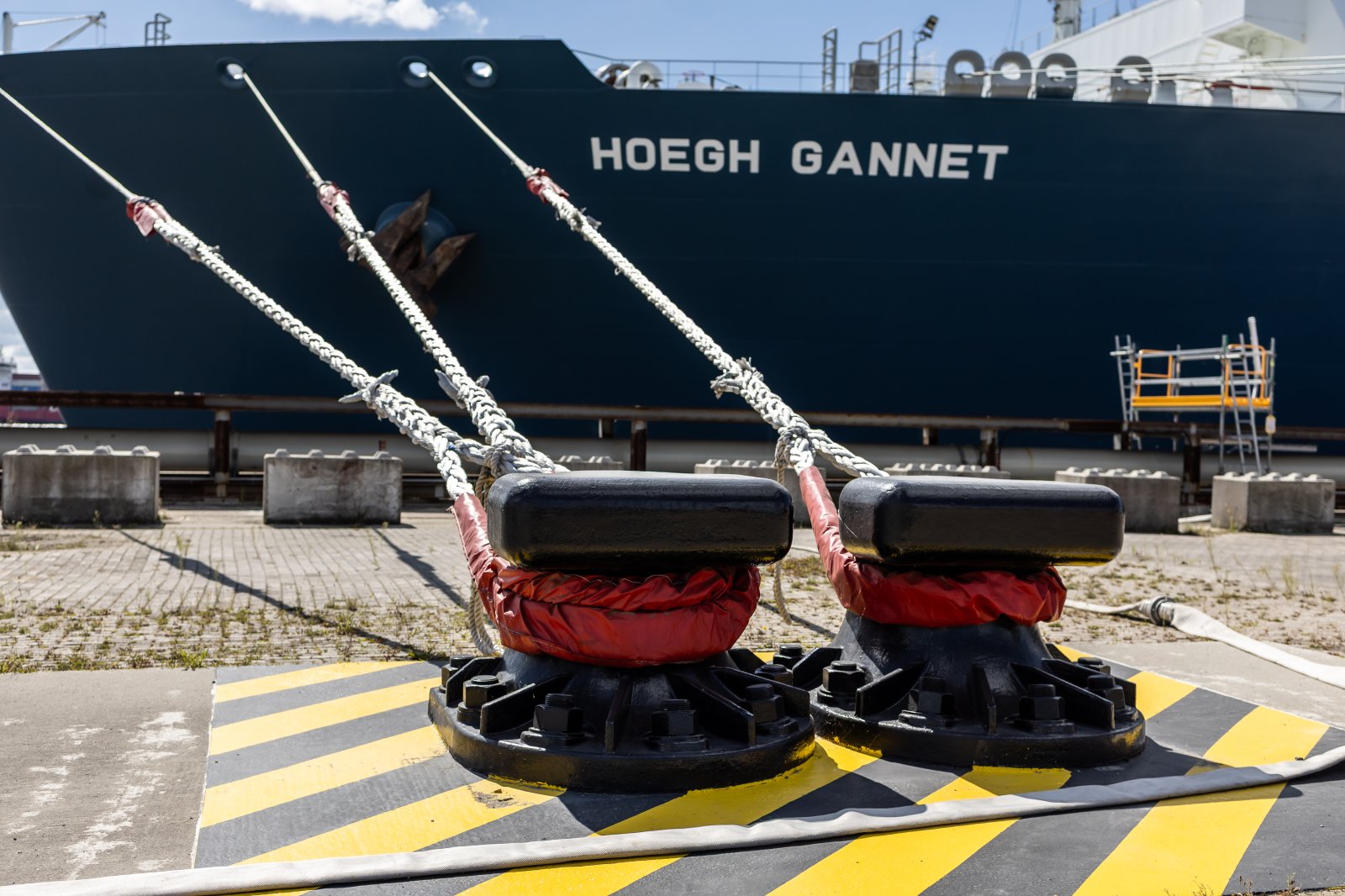
DET previously announced that the FSRU will be relocated to the yard from September 18 until the middle of November.
During its planned two-month stay at the Fayard shipyard, the FSRU was fitted with catalytic converters to further reduce air pollutant emissions and comply with the requirements of the 44th Federal Immission Control Ordinance, according to DET.
“The catalytic converters not only serve to keep the air clean but also contribute to noise reduction,” the LNG terminal operator said.
In addition, DET had the outlet pipes on the regasification vessel’s funnel rotated so that they are no longer directed towards residential areas.
DET said the absence of the FSRU was also used in the Elbe port to carry out installations on the new jetty west as well as inspections and maintenance work on the existing facilities.
Preparatory work
On November 18, Höegh Gannet berthed alongside its sister ship, Höegh Esperanza, which serves DET’s first Wilhelmshaven LNG terminal for a brief period.
Höegh Gannet was refueled with approximately 40,000 cubic meters of LNG from Höegh Esperanza to prepare for its return to Brunsbüttel, according to DET.
However, before the 297-meter-long regasification vessel moors at its central berth in the port of Elbe on November 24, preparatory work must be carried out in the port, on the loading infrastructure, and by the network operator, DET said.
This may cause higher noise levels on November 20 and 21 due to mandatory safety tests.
DET and its partner companies are “committed to minimize any unavoidable disruption to local residents.”
The schedule for the recommissioning of the FSRU terminal, which has been worked out in detail over the past few weeks, ensures that all work is “optimally timed,” DET said.
Given the tide times for arrival on November 24, noise in the early hours of the morning and on the following day cannot be completely ruled out.
“DET will exhaust all reasonable measures to minimize noise as much as possible and asks residents for their understanding in advance,” the company said.
In 2025, the FSRU has so far been able to feed around 19 terawatt hours of energy in the form of natural gas into the German gas grid.
This corresponds to the annual natural gas consumption for heating almost 1.4 million four-person households in 100-square-meter apartments in multi-family buildings, according to DET.