
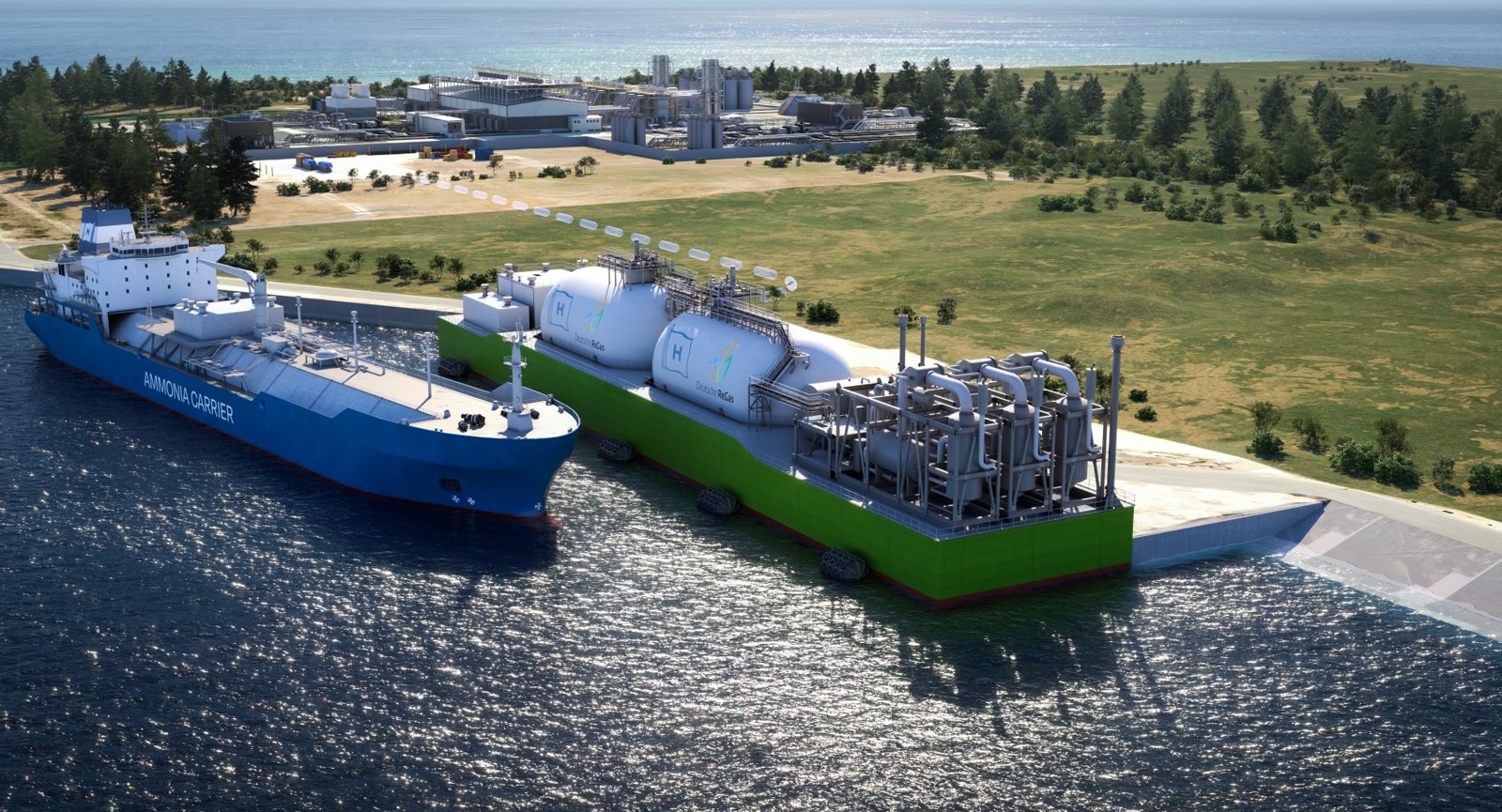
German LNG terminal operator Deutsche ReGas and Norwegian FSRU player Hoegh LNG have signed a deal to develop a floating hydrogen import terminal in the German port of Lubmin.
According to a statement by Deutsche ReGas, the two firms signed an agreement in principle to realize the “H2-Import-Terminal Lubmin”.
“The terminal will be the world’s first floating import terminal for the industrial-scale conversion of green ammonia to green hydrogen,” Deutsche ReGas said.
Deutsche ReGas expects the facility to go into operation from early 2026.
“The terminal will be the world’s first floating green ammonia cracker, producing around 30,000 tons of hydrogen per year that will be fed into the hydrogen core network via the existing feed-in point at the Deutsche ReGas terminal in the port of Lubmin,” the company said.
Moreover, the green ammonia cracker technology embedded into the barge solution has been developed by Hoegh LNG and serves as an industrial pilot for the conversion and decarbonization of FSRUs in Germany, according to Deutsche ReGas.
Deutsche ReGas said it will provide the onshore terminal infrastructure, the overall coordination of the entire project, including permitting and the marketing of the import capacities at the terminal.
Energy transition
Deutsche ReGas officially launched its Lubmin FSRU-based LNG import terminal, first private LNG terminal in Germany, in January last year.
In May, the 2009-built 145,000-cbm, FSRU Neptune, left Germany’s industrial port of Lubmin, where it served the Lubmin terminal, and will soon start serving the FSRU-based LNG terminal in Mukran.
The FSRU is 50 percent owned by Hoegh LNG and sub-chartered by Deutsche ReGas from TotalEnergies.
“Our agreement with Hoegh LNG initiates a significant new chapter in both Germany’s energy transition strategy and our company’s development,” Ingo Wagner, managing director of Deutsche ReGas said.
“Thus, our H2-Import-Terminal Lubmin is a key building block for decarbonization of the industrial regions of eastern and southern Germany,” he said.
Hoegh LNG’s CEO Erik Nyheim said importing hydrogen from global producers overseas is “key to achieving industrial decarbonization”.
“By adapting existing marine infrastructure elements with our innovative cracking solution, we can provide access to cost-competitive hydrogen within the next few years,” he said, adding that the expertise, technology, and infrastructure elements are already existing.