
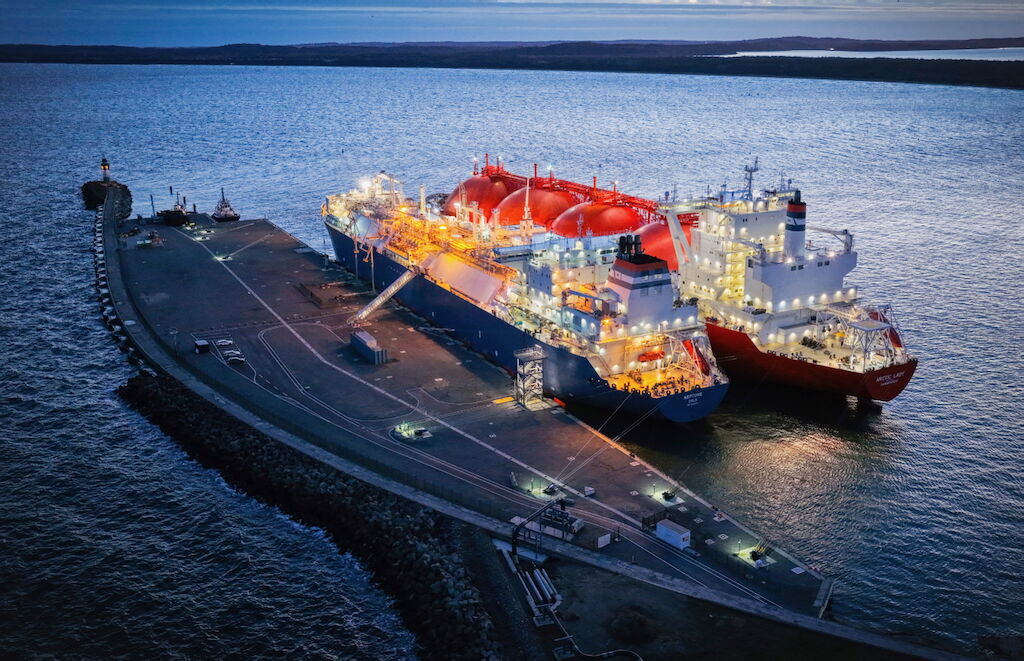
Following the successful conclusion of its 2025 open season, Deutsche ReGas has received further demand for long-term LNG regasification capacity in Northwest Europe, the company said on Thursday.
In response, the LNG terminal operator is advancing its plans to expand its facility on the Baltic Sea to the nameplate capacity of 13.5 bcma under the BNetzA regulatory exemption.
The natural gas from the Mukran LNG terminal is fed at Germany’s largest entry point into the German gas grid via 20 GWh/h of firm capacity.
Deutsche ReGas said the bidding process will be determined over the course of the first quarter.
As part of the bidding process, Deutsche ReGas invited both existing shippers and prospective new customers to enter into bilateral discussions.
“By offering further long-term regasification capacity through 2043, we are responding to the strong market perception of our terminal. At the same time, we are reinforcing energy security and providing greater planning certainty for energy suppliers and energy-intensive industries in Germany and across Europe,” Ingo Wagner, CEO of Deutsche ReGas, said.
Second FSRU
Last month, a spokesman for Deutsche ReGas told LNG Prime that the company was running a tender process to bring back a second floating storage and regasification unit at its LNG import facility in Mukran.
The Mukran LNG terminal currently consists of the 2009-built 145,000-cbm, FSRU Neptune, after Deutsche ReGas terminated the charter contract for the 174,000-cbm FSRU Energos Power with the German government.
The FSRU Neptune is 50 percent owned by Hoegh Evi and sub-chartered by Deutsche ReGas from French energy giant TotalEnergies, who also holds capacity rights at the Mukran facility along with trader MET.
In June, Deutsche ReGas and Germany’s Ministry for Economic Affairs and Energy reached a mutual agreement on resolving the sub-charter agreement for the FSRU Energos Power.
Deutsche ReGas recently filed a legal challenge against the decision of the European Commission regarding state aid of up to 4.9 billion euros ($5.86 billion) granted by Germany to state-owned DET for its FSRU-based terminals.