
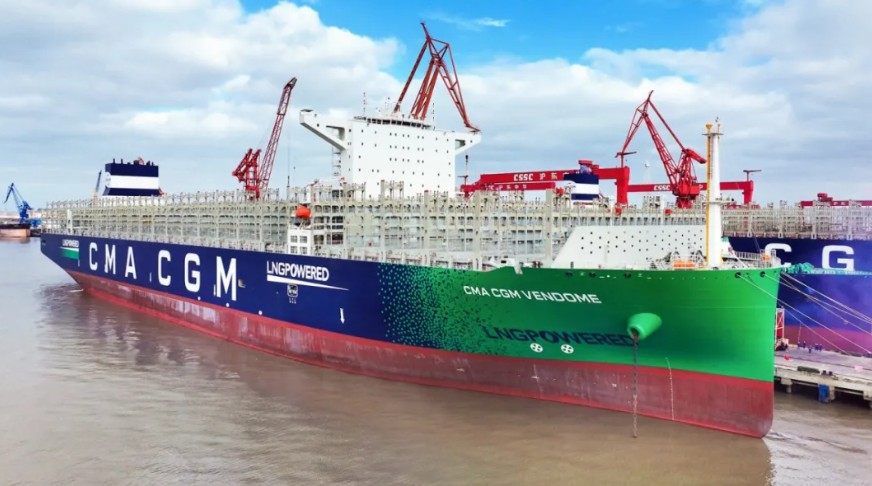
DNV said on Monday that a total of 275 orders for alternative-fueled vessels were placed in 2025, representing a year-on-year decrease of 47 percent.
This mirrored a broader drop in the overall newbuild market, which fell to 2,403 orders, from 4,405 in 2024.
Despite this downturn, containership contracting showed resilience, rising to 547 new orders from 447 in 2024 and accounting for roughly 49 percent of all gross tonnage and 68 percent of alternative-fuel new orders, DNV said.
Within the container segment, alternative fuels dominated, with the fuel mix by tonnage approximately 58 percent LNG, 36 percent conventional fuels, and 6 percent methanol.
Reflecting the container segment’s strength, LNG-fueled vessels led the alternative-fueled market across all ship types in 2025, accounting for 188 orders and representing 31 percent of total GT, DNV said.
LNG-fueled vessel orders dropped 29 percent compared to 2024, while in December, there were orders for 28 LNG-powered vessels.
Methanol orders fell to 61 from 149 in 2024, while ammonia and LPG saw only limited order uptake.
LPG and ethane tanker orders fell by 73 percent from 2024 to 2025.
Similarly, bulk carriers, crude oil tankers, and oil/chemical tankers all saw pronounced year-over-year declines, reflecting a continued focus on cost efficiency and fewer immediate incentives for owners to commit to alternative fuels, DNV said.
DNV noted that car carrier orders paused sharply after several years of strong activity, declining by 90 percent compared to the previous year.
LNG and methanol are supported by established supply chains
“The resilience of the alternative fuels orderbook in 2025 is mainly driven by cargo owners who have set their own emissions reduction goals despite market slowdown and regulatory uncertainty,” Jason Stefanatos, global decarbonization director at DNV Maritime, said.
“We see them prioritizing investments where there is a strong alignment between fuel infrastructure, regulatory certainty, and commercial viability, particularly in container shipping, where LNG and methanol are supported by established supply chains and customer demand,” he said.
“In contrast, segments like bulk and tanker are more sensitive to market cycles and capital costs, leading to a preference for conventional fuels until further clarity emerges on fuel lifecycle emissions and regulatory incentives. Practically, this environment should encourage owners to focus on scalable solutions, invest in fuel flexibility, and adopt targeted energy efficiency measures that can be adapted as policy and market conditions evolve,” Stefanatos said.
22 LNG bunkering vessels
According to the classification society, investment in fuel infrastructure continued at pace with 22 LNG bunkering vessels added to the orderbook alongside new bunkering vessels capable of supplying methanol and biofuel.
These developments signal growing confidence in LNG supply chains and emerging multi-fuel capabilities, reducing operational risk and supporting the economics of alternative fuel adoption, DNV said.
Wind-assisted propulsion systems (WAPS) saw 24 ships delivered in 2025, with a total of 63 sails installed, slightly up from 2024, which saw 22 deliveries and a total of 49 sails installed.
846 LNG-powered ships in operation
DNV’s Alternative Fuels Insight (AFI) platform shows that there are now 846 LNG-powered ships in operation and 642 LNG-fueled vessels on order.
Moreover, 229 LNG-powered containerships and 124 LNG-powered car carriers are in operation, followed by 82 crude carriers, and 80 oil/chemical tankers.
As per vessels on order, LNG-powered containerships account for a big part of the orders with 395 units. Shipping firms also ordered 98 car carriers, 48 crude oil tankers, and 39 oil and chemical tankers.
These statistics do not include smaller inland vessels or dual-fuel LNG carriers.
In addition to 1488 confirmed LNG-powered ships, the fleet powered by alternative fuels includes 450 methanol-fueled vessels, 300 LPG-powered ships, 49 ammonia-fueled vessels, and 40 hydrogen-fueled vessels.