
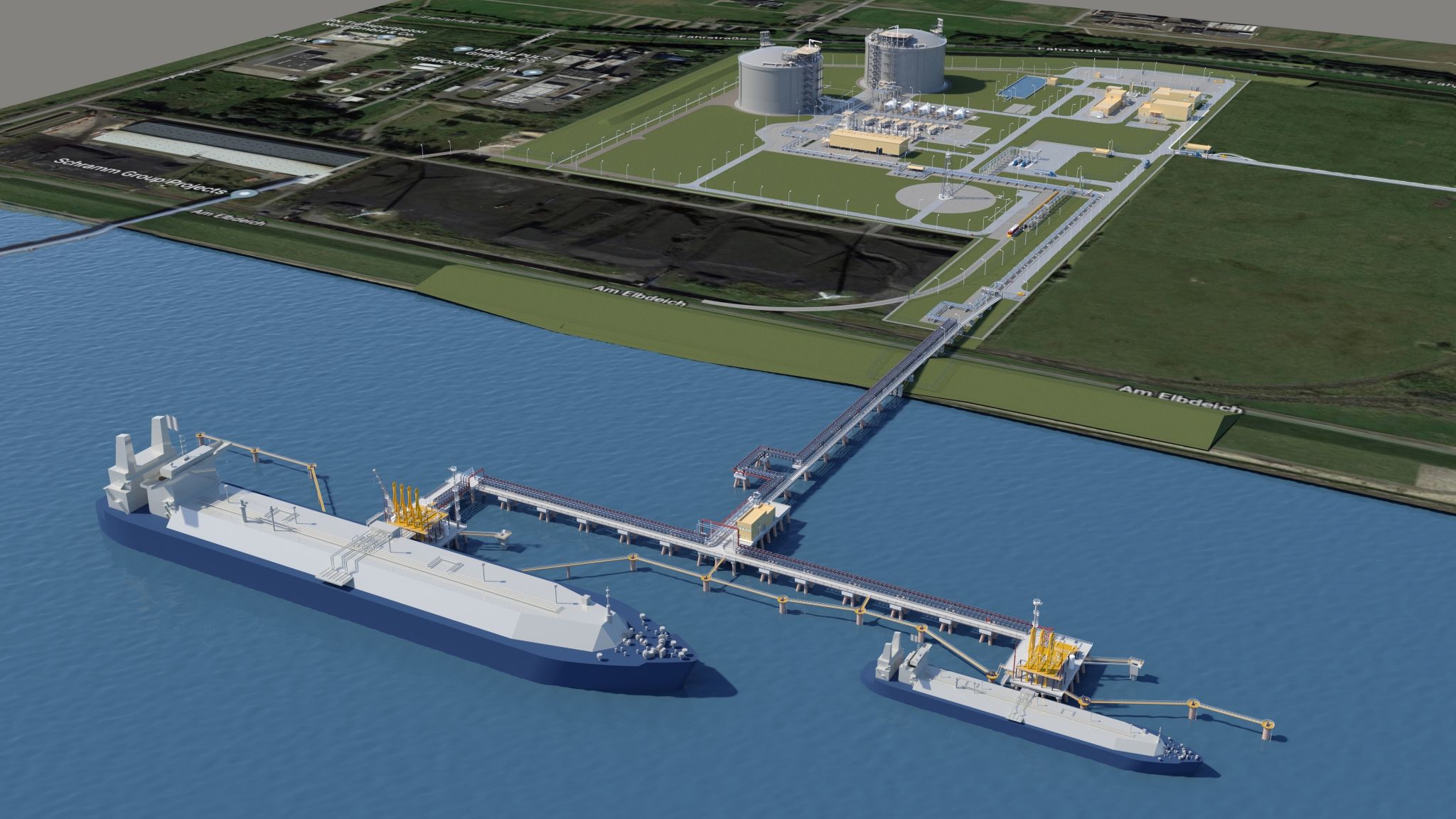
The order was placed as a subcontractor to main contractor CS Gas North, a collaboration between Spanish companies Cobra and Sener, a spokesman for German LNG Terminal told LNG Prime.
The spokesamn did not provide the price tag of the contract.
German LNG Terminal, a joint venture which includes Dutch gas grid operator Gasunie and German energy firm RWE, expects construction of the sea jetty to start in summer 2025.
Moreover, the jetty is expected to be completed by the end of 2026.
Ballast Nedam and Hakkers Waterbouw said in a separate statement that the new jetty will be capable of receiving LNG carriers with up to 267,000 cbm capacity.
In addition to the main jetty, a smaller berth will also be built for LNG bunkering ships and barges.
This jetty offers an unloading capacity of 14,000 cbm per hour and a loading capacity of 3,000 cbm per hour.
The Dutch duo added that various crane vessels, floating sheerlegs, and pontoons will be deployed during construction.
German LNG terminal
Last year, Gasunie and RWE made the final investment decision on the onshore LNG import terminal in Brunsbüttel.
Before the decision, the JV also kicked off preparatory activities, including site installation and fencing, earthworks to consolidate and drain the land areas, and construction of roads and access routes.
Gasunie has a 40 percent operating stake in the facility, RWE has 10 percent, while the German government, through KfW, holds 50 percent.
The terminal is expected to regasify and feed some 10 billion cubic meters of natural gas into the German grid.
US energy giant ConocoPhillips, UK’s Ineos, and RWE have previously agreed to book long-term capacity at the onshore LNG import facility.
German LNG Terminal previously said the three initial clients had booked 90 percent of the long-term capacity, while 10 percent of the capacity is still available and open for short-term bookings.
Brunsbüttel already hosts the Elbehafen FSRU-based LNG import terminal.
Once in operation, the new land-based LNG terminal will replace the current FSRU-based facility.
The 170,000-cbm FSRU Hoegh Gannet, which serves the Elbehafen LNG import terminal Brunsbüttel, started supplying regasified LNG to the German grid on March 22, 2023, as part of the commissioning phase.