
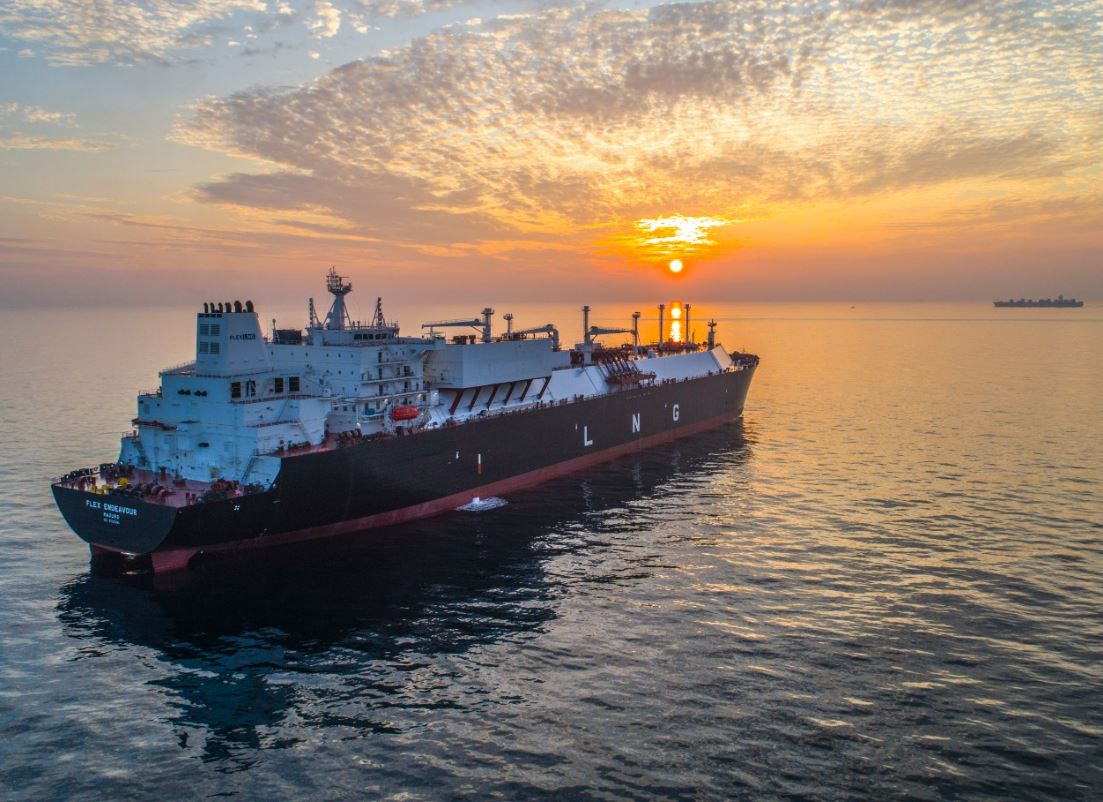
Norwegian shipping firm Flex LNG reported a higher net income while its vessel operating revenue dropped in the January-March period when compared to the same quarter last year.
Flex said on Wednesday its quarterly revenue reached $74.6 million, compared to record $114.6 million in the prior quarter and $81.3 million in the same period last year.
Net income of $55.8 million rose from $47.2 million last year, but it declined compared to record $69.4 million in the prior quarter.
Also, average time charter equivalent (TCE) rate reached $62,657 per day for the first quarter, a big drop when compared to $95,908 per day in the prior quarter, the shipping company controlled by billionaire John Fredriksen said.
Flex LNG “upbeat” about prospects of recontracting three ships
During the last 13 months, the company has secured in total nine fixed hire time charters for its fleet of 13 LNG carriers, including the recent charter for the fifth LNG carrier to US LNG player Cheniere.
“The minimum period of these contracts ranges from three to five years which gives us comfortable earnings visibility,” Øystein Kalleklev, CEO of Flex LNG, said in the company’s quarterly report.
“We still have three ships which will be redelivered from existing time charterers during the next 23 months and given the strong term market and general lack of available modern tonnage we are upbeat about the prospects of recontracting these ships at attractive terms,” he said.
Kalleklev said the quarterly revenue of $74.6 million matches the company’s revenue guidance communicated in February.
“With 98 percent contract coverage for the year and three of our 13 ships on variable hire contracts linked to the spot market, we do expect gradual increased revenues in the next three quarters as we also guided in February,” he said.
“Given the strong backlog, positive outlook and our very solid financial position, the board is therefore again declaring a dividend for the quarter of 75 cents per share,” the CEO said.
“Challenging” spot market
US LNG supplies to Europe surged this year due to strong prices and as European countries look to reduce reliance on Russian gas.
Kalleklev said that the first quarter was a “fantastic period” to be a cargo owner with high demand and elevated prices for LNG given the global energy crunch.
For the spot freight market, the first quarter was however “challenging” as the LNG trade abruptly shifted towards Europe resulting in lower sailing distances and thus higher availability of ships depressing freight economics as liquidity in the spot market also dried up, he said.
“The sentiment in the freight market did however turn positive during the end of February and spot rates for modern tonnage have now recovered to above seasonal average while the one-year and three-year time charter rates for remains very strong,” Kalleklev said.
“This is evidencing that charterers are willing to pay a substantial premium to spot rates in order to lock in large fuel-efficient ships on longer periods as the forward market also price in a much tighter freight market in the second half of the year,” the CEO added.