
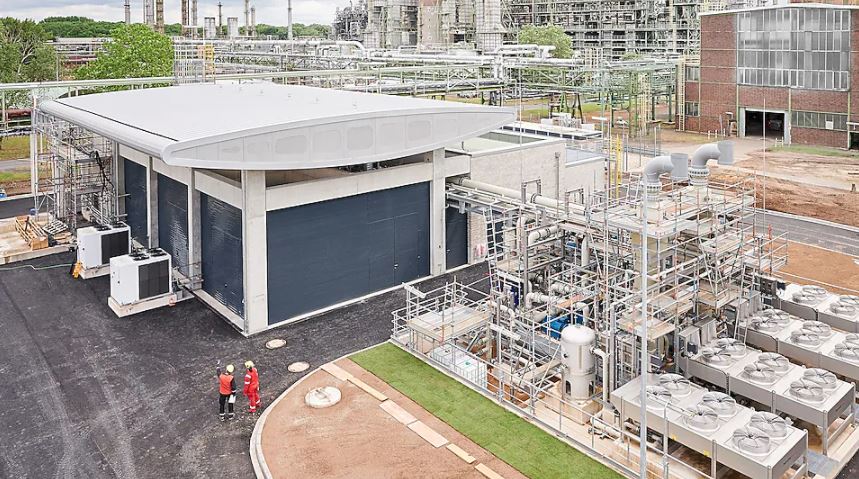
LNG giant Shell has launched what it says is Europe’s biggest hydrogen electrolysis plant at its Rheinland refinery near the German city of Cologne.
Shell says the plant located at the firm’s energy and chemicals park Rheinland and backed by a European consortium would “accelerate hydrogen production and contribute to Europe’s goal to achieve climate neutrality.”
As part of the Refhyne European consortium and with European Commission funding through the fuel cells and hydrogen joint undertaking, the fully operational plant is the first to use this technology at such a large scale in a refinery, according to a Shell statement.
Moreover, plans are under way to expand capacity of the polymer electrolyte membrane (PEM) electrolyser from 10 megawatts to 100 megawatts at the Rheinland site, where Shell also intends to produce sustainable aviation fuel using renewable power and biomass in the future.
Shell is also developing a bio-LNG plant that would supply the company’s network of LNG stations by trucks.
“This project demonstrates a new kind of energy future and a model of lower-carbon energy production,” Shell’s downstream director, Huibert Vigeveno, said at the plant’s official opening ceremony on July 2.
Shell is looking to become a “leading supplier” of green hydrogen for industrial but also transport customers in Germany.
Vigeveno said Shell would be involved in the whole process — from power generation, using offshore wind, to hydrogen production and distribution across sectors.
“We want to be the partner of choice for our customers as we help them decarbonise,” he said.
1,300 tonnes of green hydrogen a year
Shell has a target to become a net-zero-emissions energy business by 2050.
As part of its strategy, Shell plans to transform its refinery footprint to five core energy and chemicals parks. This means Shell would reduce the production of traditional fuels by 55% by 2030, according to the statement.
The Rheinland electrolyser will use renewable electricity to produce up to 1,300 tonnes of green hydrogen a year. Shell will initially use this to produce fuels with lower carbon intensity.
In addition, Shell would use green hydrogen to help decarbonise other industries, it said.
The European consortium backing the project consists of Shell, ITM Power, research organisation SINTEF, but also consultants Sphera and Element Energy.
Furthermore, ITM power in Sheffield, UK, built the electrolyser that includes parts made in Italy, Sweden, Spain and Germany.