
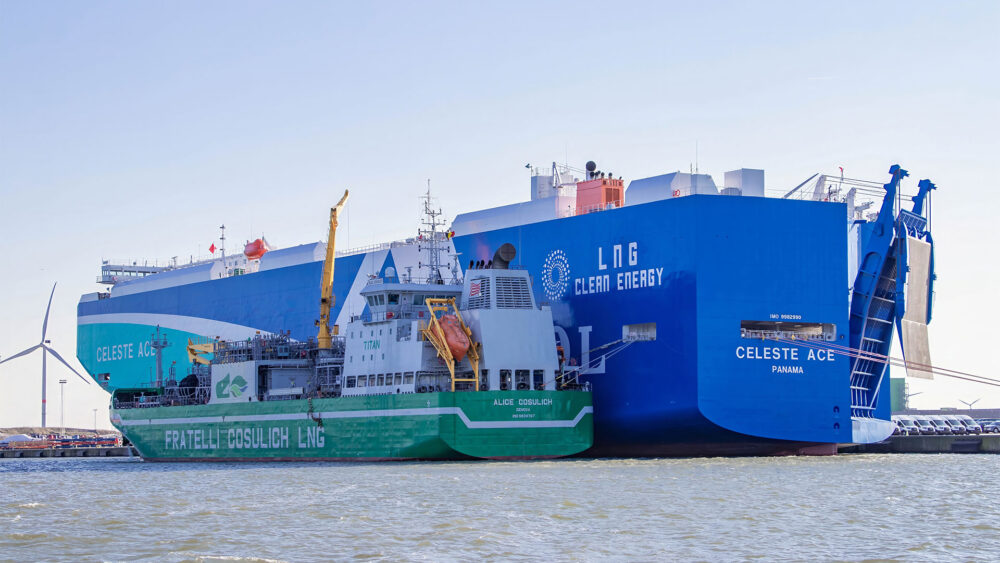
Madrid-based Molgas, which completed the purchase of Titan last year, said in a statement on Monday that Titan operates seven LNG bunkering vessels and can deliver to around 52 ports today, so the new e-methane agreement can help to “significantly scale up green fuel supply.”
TURN2X’s modular and load-flexible production plant in Miajadas, Spain, converts renewable energy and biogenic CO₂ into ISCC-certified e-methane.
This fuel is then fed into the grid and transported to major European ports, where Titan bunkers it to ship operators, Molgas said.
Molgas noted that e-methane can be ‘dropped into’ all existing LNG infrastructure with little to no modification required – including bunkering equipment, terminals, and LNG dual-fuel vessels.
This means e-methane is supported by LNG bunkering infrastructure in approximately 222 ports worldwide and can be used in around 850 LNG-fuelled vessels currently in operation and a further 642 on order, it said.
Molgas claims e-methane can achieve net-zero greenhouse gas (GHG) emissions on a well-to-wake basis, with exact reductions depending on the equipment and engine technology used.
It also offers up to a 95 percent reduction in nitrogen oxides (NOx) and achieves virtually zero sulphur oxides (SOx) and particulate matter (PM) emissions, such as black carbon (soot), the company said.
These emissions reductions mean ships using e-methane will be eligible for FuelEU Maritime overcompliance and the commercial benefits of banking and pooling.
Molgas said that this deal also represents a “concrete step toward industrial-scale e-methane deployment and making European energy more resilient.”
“With the EU now committed to phasing out Russian LNG, ending short-term contracts from April 25 this year and all long-term contracts from January 1, 2027, scaling up the production of green fuels like e-methane can directly support energy security,” the company said.