
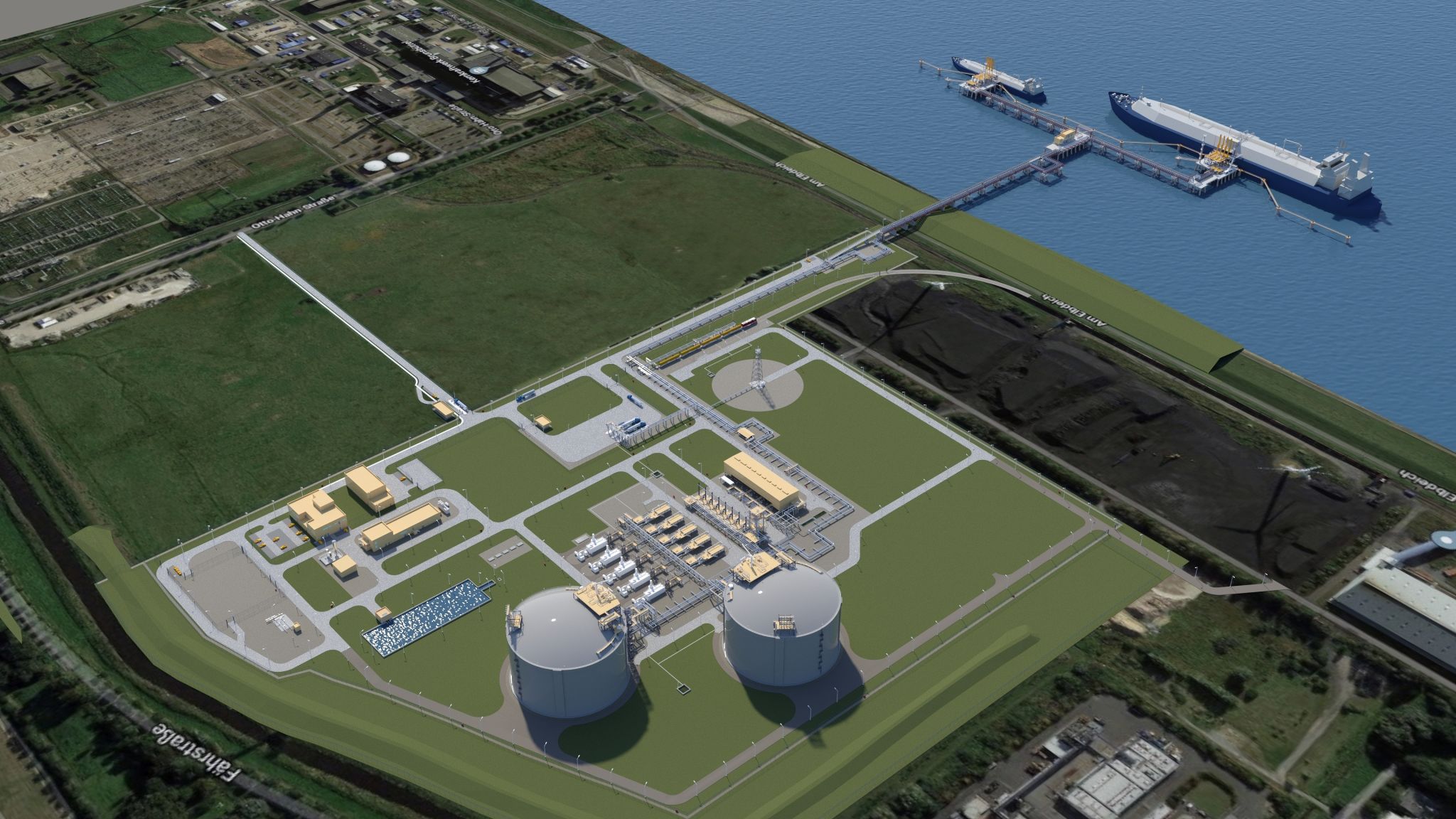
“The FID was taken within the last two weeks,” a spokesman for German LNG Terminal told LNG Prime on Tuesday.
The JV recently received planning approval from the local government.
One of the requirements for the formal FID was the issuing of this planning approval for the construction of the land and water-side harbor infrastructure, he said.
“However, regardless of this pending approval, all three shareholders have made very clear from the signing of the MoU in March 2022 onwards, that they jointly will give full support to the project,” the spokesman said.
Earlier this year, the JV also kicked off preparatory activities, including site installation and fencing, earthworks to consolidate and drain the land areas, and construction of roads and access routes.
Gasunie has a 40 percent operating stake in the facility, RWE has 10 percent, while the German government, through KfW, holds 50 percent.
The terminal is expected to regasify and feed some 10 billion cubic meters of natural gas into the German grid.
US energy giant ConocoPhillips, UK’s Ineos, and RWE have previously agreed to book long-term capacity at the onshore LNG import facility, while a unit of French construction company Vinci and Spanish engineering firm Sener won the EPC contract.
German LNG Terminal previously said the three initial clients had booked 90 percent of the long-term capacity, while 10 percent of the capacity is still available and open for short-term bookings.
Costs
The spokesman did not provide the exact figures for the project costs.
Previously, the JV expected that the project would cost about 1.3 billion euros ($1.43 billion).
Recent reports suggested that the costs increased by 200 million euros.
“The recently discussed additional expenditure is indeed, to a large extent, already an investment for the fossil-free era,” the spokesman said.
He said the terminal’s “most striking features” are the two 165,000-cbm LNG tanks, which will have thicker walls and foundations in order to be directly suitable for hydrogen.
“They stand on around 2,800 piles per tank, which would not have been necessary for LNG, i.e. natural gas, alone,” he said.
The spokesman said that German LNG Terminal “will do everything in its power to be able to go into regular operation as early as possible in 2027.”
“In addition, the best possible fossil-free subsequent use will be considered and planned in advance. It has been determined that from the end of 2043, continued operation will only be permitted for climate-neutral hydrogen and its derivatives,” he said.
German FSRUs
Brunsbüttel already hosts the Elbehafen FSRU-based LNG import terminal.
Once in operation, the new land-based LNG terminal will replace the current FSRU-based facility.
The 170,000-cbm FSRU Hoegh Gannet, which serves the Elbehafen LNG import terminal Brunsbüttel, started supplying regasified LNG to the German grid on March 22, 2023, as part of the commissioning phase.
RWE developed the project with Hoegh LNG, Brunsbüttel Ports, and also other partners on behalf of the German government.
State-owned German LNG terminal operator DET operates this facility, the first Wilhelmshaven terminal, and the upcoming FSRU-based LNG import terminals in Stade and Wilhelmshaven.
In addition, private firm Deutsche ReGas recently launched commercial operations at its Mukran FSRU-based LNG terminal, which can handle up to 13.5 bcm per year.
Germany is expected to have five operational FSRU-based facilities by the end of this year.
Earlier this year, Germany’s Hanseatic Energy Hub officially started building its Stade LNG onshore import terminal near Hamburg, which is worth about 1 billion euros.
HEH says this is Germany’s first onshore LNG terminal.
In March, HEH’s shareholders Partners Group, Enagas, Dow, and Buss Group took a positive final investment decision on the project.