
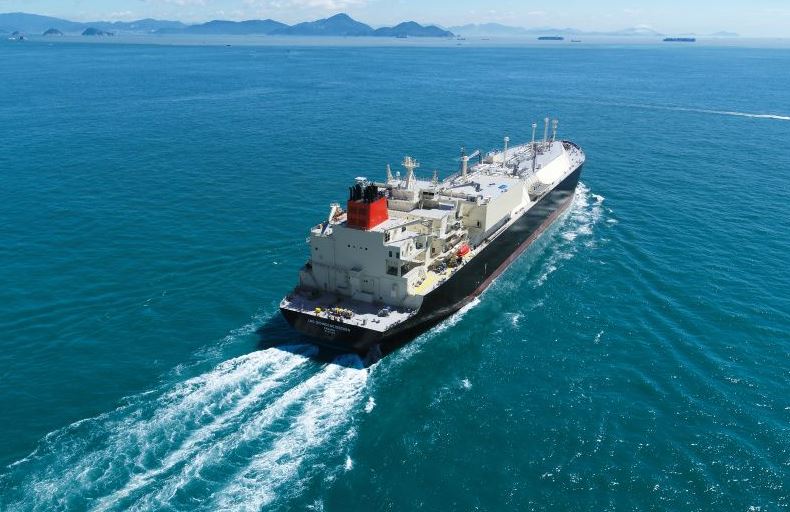
Uniper and RWE have secured three floating storage and regasification units (FSRUs), as Germany looks to replace Russian gas with LNG, according to the country’s Economy Minister, Robert Habeck.
The two firms secured the FSRUs on behalf of the government, Habeck said in a statement on Friday released by the German Ministry for Economic Affairs and Climate Action.
According to the Ministry, the companies are finalizing the charter deals for the units.
The government is currently “examining potential sites in the North Sea and the Baltic where these can be deployed quickly – in some cases in time for the winter of 2022/23,” it said.
“The leasing of the three FSRUs can gradually make it possible to land (in the final stage in summer 2024) around 27 billion cbm of LNG. This means that 7.5 billion cbm of LNG will be available for the market in time for the winter of 2022/2023,” the Ministry said.
Germany is a major gas importer and the country imported just under 90 bcm of natural gas in 2021.
The country gets about 55 percent of these supplies from Russia, followed by Norway with about 30 percent, and the Netherlands with about 13 percent, according to the Ministry.
Germany currently has no large LNG import terminals.
By diversifying supplies, Habeck said that Germany could become largely independent of Russian gas by mid-2024.
Habeck and German firms such as Uniper and RWE recently visited both Qatar and UAE. German firms will now work on long-term LNG supplies with QatarEnergy, while they also signed several hydrogen deals with Adnoc.
Several projects in the pipeline
This move to secure FSRUs comes just weeks after Chancellor Olaf Scholz said Germany had decided to back the construction of two LNG import terminals as part of efforts to reduce dependence on Russian pipeline gas imports.
After that, Dutch gas grid operator Gasunie joined forces with the German government and RWE to build the Brunsbuettel LNG import terminal, while Shell signed a deal to book capacity at the planned facility. Gasunie also secured a small FSRU from Belgian shipowner Exmar for its planned terminal in Dutch Eemshaven, which is close to the German border.
Uniper, a unit of Finland’s Fortum, also confirmed it had revived plans to build an LNG import terminal in Germany’s Wilhelmshaven. In addition, the company booked more capacity at the Dutch Gate terminal in Rotterdam.
Besides these two projects in Brunsbuettel and Wilhelmshaven, Germany’s Hanseatic Energy Hub is also working on the Stade LNG import terminal near Hamburg.
Also, Belgium-based Tree Energy Solutions (TES) is looking to import both LNG and hydrogen via a planned hub in Wilhelmshaven.