
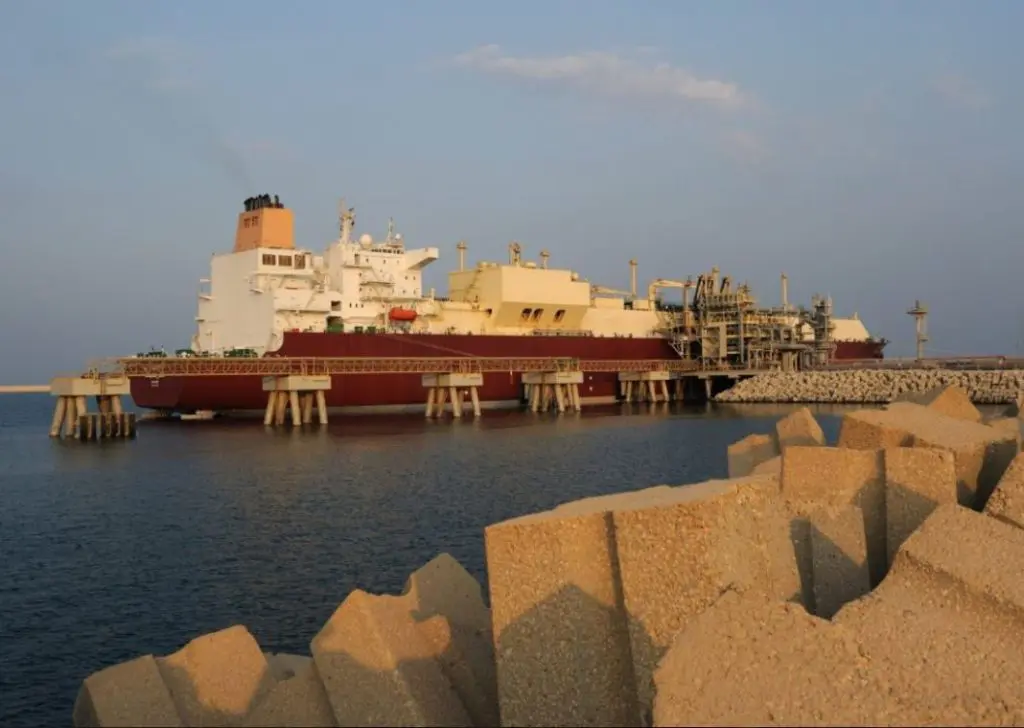
QatarEnergy said in a statement on Wednesday that “emergency response teams were deployed immediately to contain the resulting fires, as extensive damage has been caused.”
“All personnel have been accounted for and no casualties have been reported at this time,” the company said.
QatarEnergy added that it “will continue to communicate the latest available information.”
The LNG producer did not provide further details on which facilities were affected.
In addition to liquefaction trains, the complex hosts many other facilities, including condensate facilities, helium facilities, Shell’s Pearl GTL, and others.
Qatar’s Ministry of Interior said in a social media post that the “civil defense team is responding to a fire in the Ras Laffan area following an Iranian targeting.”
In a separate social media post, Qatar’s Ministry of Defense said that Qatar was “subjected on Wednesday to an attack involving ballistic missiles launched from the Islamic Republic of Iran.”
According to the ministry, Qatar’s armed forces “successfully intercepted four of the ballistic missiles, while one missile fell in Ras Laffan Industrial City, causing a fire.”
Second attack hits LNG facilities
QatarEnergy announced in a new statement early on Thursday local time that, in addition to the previous attack on Ras Laffan Industrial City that resulted in “extensive damage to the Pearl GTL (gas-to-liquids) facility”, there was a second attack.
“QatarEnergy confirms that in the early hours of Thursday, March 19, 2026, several of its liquefied natural gas (LNG) facilities were the subject of missile attacks, causing sizeable fires and extensive further damage,” it said.
“Emergency response teams were deployed immediately to contain the resulting damage with no reported casualties,” the company said.
Qatar’s Ministry of Defense provided an update on Thursday morning local time, saying that “civil defence has fully contained all fires in the Ras Laffan Industrial area without recording any injuries, with cooling and securing operations continuing at the sites, while the explosives unit affiliated with the Internal Security Force (Lekhwiya) carries out its tasks in dealing with any hazardous parts.”
Reuters also reported on Thursday, citing QatarEnergy CEO Saad al-Kaabi as saying that Iranian attacks have “knocked out 17 percent of Qatar’s liquefied natural gas (LNG) export capacity, causing an estimated $20 billion in lost annual revenue.”
He reportedly said that two of Qatar’s 14 LNG trains and one of its two gas-to-liquids (GTL) facilities were damaged in the strikes.
“The repairs will sideline 12.8 million tons per year of LNG for three to five years,” the report said.
QatarEnergy may have to declare force majeure on long-term contracts for up to five years for LNG supplies bound for Italy, Belgium, South Korea, and China due to the two damaged trains, al-Kaabi reportedly said.
Giant LNG plant
The first attack came hours after Iran said that it would attack oil and gas facilities across the Gulf region in retaliation for Israeli attacks on its South Pars gas facilities, according to several media reports.
Iran and Qatar share the giant South Pars (Iran)/North Dome(Qatar) offshore gas field.
QatarEnergy stopped producing LNG at its giant Ras Laffan complex on March 2 due to military attacks on its operating facilities, with Qatar’s Ministry of Defence saying that “Qatar was attacked by two drones launched from the Republic of Iran.”
The LNG producer declared force majeure to its affected LNG buyers on March 4.
LNG prices and shipping rates surged after these announcments with many countries such as Bangladesh and India opting to buy expensive spot LNG cargoes to secure needed supplies.
Qatar is one of the world’s largest LNG producers.
QatarEnergy is currently working on the giant North Field LNG expansion program, which includes the North Field South, North Field East, and North Field West projects.
Together, these will raise Qatar’s LNG production capacity in Ras Laffan from the current 77 mtpa to 142 mtpa in 2030.