
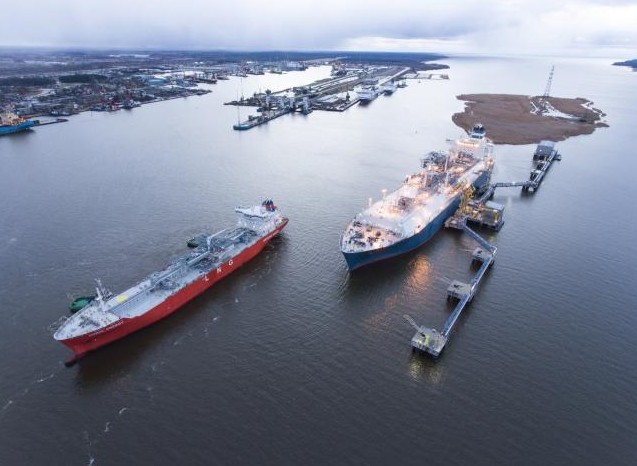
Earlier this year, KN said that it plans to introduce this service at its Klaipeda LNG terminal.
KN said in a statement on Wednesday that the first operation took place during the weekend.
According to the LNG terminal operator, bio-LNG was loaded onto the Coral Energy bunkering vessel, chartered by Finland’s Gasum (the buyer), while virtual biomethane liquefaction at the terminal was carried out by Norwegian energy firm Equinor (the seller).
KN said that bio-LNG is biomethane liquefied from the gas network and produced from raw materials located in Europe, which will enable customers to reduce their carbon footprint by using the infrastructure of the Klaipeda LNG terminal.
The company noted that this service will enable biomethane producers and suppliers to integrate their operations into the LNG logistics chain and to market gas produced both in Lithuania and across Europe – gas that is available within the interconnected European gas network.
“By completing the first virtual biomethane liquefaction operation, the Klaipeda LNG terminal has become the first terminal in the Baltic region to offer such a service. Currently, only a few of the 28 operating LNG terminals in Europe provide biomethane liquefaction or virtual liquefaction services,” said KN’s CCO Mindaugas Navikas.
FSRU Independence
Last December, KN Energies assumed ownership of the FSRU Independence from Hoegh Evi, and the unit was registered under the Lithuanian flag.
In March this year, the FSRU Independence completed its 500th ship-to-ship LNG transfer in Klaipeda since the start of operations in 2014.
The majority of LNG volumes originate from Norway and the United States, but the Klaipeda FSRU-based facility has also received LNG from Nigeria, Trinidad and Tobago, Egypt, Algeria, and other countries.
During the first half of this year, the FSRU completed 42 STS operations, compared to 30 STS operations in the same period last year.
The unit received 924,000 tonnes of LNG in January-June, compared to 686,000 tonnes last year.
According to KN, the FSRU regasified 1,236 billion nm3 of natural gas and supplied it to the natural gas transmission system in the first half.
This compares to 0.795 billion nm3 in the first half of 2024.