
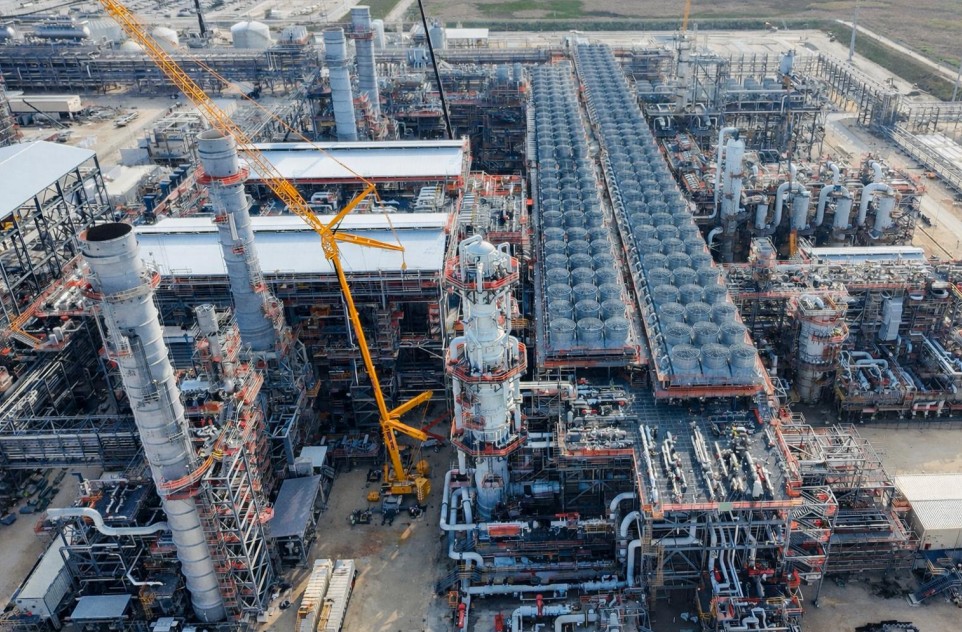
FERC said on Wednesday that it granted Golden Pass LNG’s March 17 request to introduce hazardous fluids into the Train 1 regen gas system.
Golden Pass noted in its request that on January 29, FERC approved a notice to proceed (NTP) to introduce hazardous fluids to the warm end systems of Train 1 and the sendout compressor.
On February 25, FERC approved an NTP to introduce hazardous fluids into the cold end and condensate storage systems.
These systems included refrigeration, liquefaction, HRSG 1&2 FG lines, and condensate storage.
Last month, WoodMackenzie data showed that, after minimal initial gas flows into the Golden Pass facility since July last year, nominations ramped up to over 0.3 bcfd over the President’s Day holiday weekend.
ExxonMobil CEO Darren Woods said earlier this year he expects the QatarEnergy-led Golden Pass LNG export project to produce first LNG volumes in early March.
He said that Train 1 achieved mechanical completion late in the last year.
State-owned QatarEnergy, whose LNG and other facilities in Ras Laffan were attacked on Wednesday and Thursday, owns a 70 percent stake in the three-train Golden Pass project with a capacity of more than 18 mtpa and will offtake 70 percent of the capacity, while US energy firm ExxonMobil has a 30 percent share.
A joint venture of Chiyoda, McDermott, and Zachry won the EPC contract to build the three Golden Pass trains worth about $10 billion next to the existing LNG import terminal in the vicinity of Sabine Pass, Texas.
However, Zachry Holdings said in May 2024 that it had filed for bankruptcy, initiating a structured exit from the Golden Pass LNG export project due to “financial challenges” related to the facility’s construction.
In November 2024, Japan’s Chiyoda and McDermott’s CB&I reached a deal with Golden Pass LNG to complete the construction of the first liquefaction train following the exit of Zachry.
Additionally, Chiyoda and McDermott signed a revised EPC contract with Golden Pass LNG in November 2025 to complete the construction of the second and third liquefaction units.