
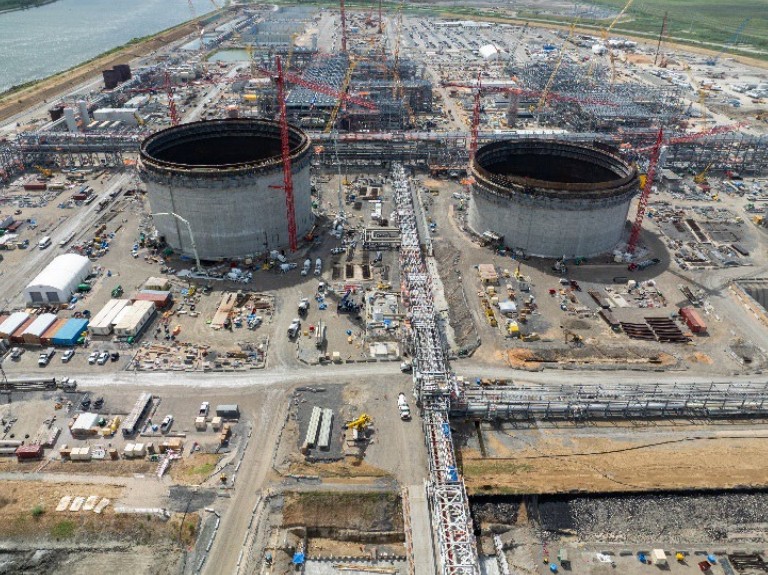
The incident took place at Sempra Infrastructure’s Port Arthur LNG construction site in Texas on April 29, 2025.
According to a statement by Bechtel, Craig Albert, president and chief operating officer, and Paul Marsden, president, energy, sent a message to Bechtel colleagues on Tuesday.
They said that the five-person crew at the Port Arthur LNG facility was performing “tank work at elevation when the climbing formwork system on which they were standing gave way.”
“Three of our colleagues, Reginald Magee, Felipe Mendez, and Felix Lopez Sr., lost their lives, while two others were injured,” Albert and Marsden said.
“In the wake of the incident, we committed to understanding how this devastating loss could happen. We’ve been cooperating fully with the Occupational Safety and Health Administration (OSHA), and we welcome the results of their investigation. In addition to cooperating with OSHA, we carried out our own internal investigation, and we promised to share our findings publicly,” they said
“This report provides a detailed account of what went wrong, along with the actions we are taking to address our shortcomings. As you will see, there was no single, isolated cause of the incident—we identified multiple contributing factors,” Albert and Marsden said.
“One of the most important takeaways from our review is the role that safety culture played—and, in some cases, failed to play. Safety culture isn’t the same everywhere. It can shift from project to project, crew to crew, and even task to task. In reviewing the incident, we found breakdowns in oversight and supervision, where moments to step in and take corrective action were missed,” they said.
“Formwork jumping”
When the incident occurred, the crew was at elevation performing a standard task used in building LNG tanks known as “formwork jumping.”
Bechtel explanied that it involves lifting the multilayered formwork system—including the platform on which the team stands once the system is in place—and resetting it higher on the tank to tie the reinforcing steel and pour the next elevation of the concrete wall.
According to Bechtel, the crew had successfully jumped and set eight sections during their shift and was setting the last section at the time of the incident.
Bracket connection
Bechtel said that its investigation determined that, while setting the final section, the bracket connection on the formwork was not securely attached to the cone screw, a form of steel bolt with an integrated washer.
The cone screw is screwed into an embed, which is cast into the concrete wall of the tank. Each panel of the formwork has two vertical brackets, each connected to a cone screw that secures the panel to the tank wall, the company said.
In this case, the left-side bracket came to rest on top of the integrated washer, or on the bolt head, rather than its proper place on the shaft. As a result, the platform was unstable and susceptible to breaking free. Although the formwork remained supported for a time, it was not fully secured—something the crew was unaware of, Bechtel said.
“Once the crew gave the crane operator approval to release the rigging used to lift the formwork into position, the unsecured bracket connection allowed the formwork to slip off. The left side of the formwork dropped to an angle that led to the crew falling off the platform,” Bechtel said.
Fall protection
Bechtel said that all five crew members involved in the formwork jumping were wearing project-provided personal fall arrest system equipment.
“When the formwork rotated, the three individuals who suffered fatal injuries appeared not to have their fall arrest lanyards attached to an approved anchorage point. The other two crew members attached their lanyards to an approved anchorage point and experienced an arrested fall,” the company said,
According to Bechtel, all five crew members had received the fall protection training provided to all new craft professionals as part of their induction training.
Training, safety culture
Bechtel said that other factors that contributed to the incident include inadequate training, the absence of an experienced crew member at the time of the incident, noncompliance with Bechtel’s mentoring process, high-risk work on the night shift, and safety culture.
“Two additional workers (the foreman and the leading hand) assigned to the crew were experienced and knowledgeable in jumping formwork and fit to identify and correct hazards, but they were not physically present on the formwork at the time of the incident,” Bechtel said.
“Both the foreman and leading hand had been with the crew for most of the shift but had been called away to assist elsewhere shortly before the incident,” the company said.
Bechtel said it has “always been committed to fostering a strong safety culture rooted in our company’s values.”
“This incident showed us that, for this particular work, our culture was not applied consistently from senior management all the way to the workface,” the company said.