
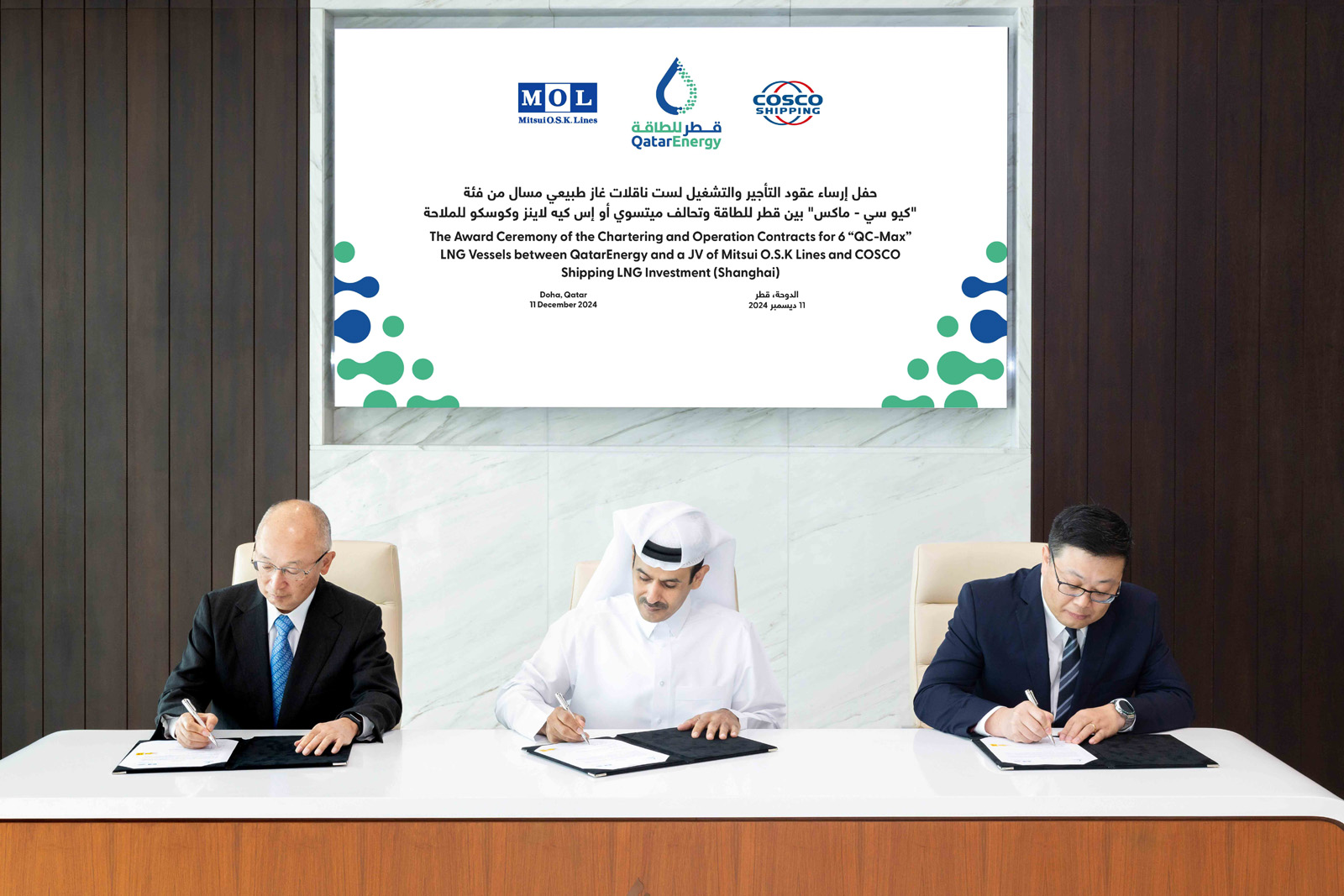
QatarEnergy said on Wednesday it has selected the joint venture of MOL and Cosco Shipping LNG Investment (Shanghai) to own and operate 6 QC-Max size LNG vessels.
The LNG giant said the long-term time charter party (TCP) agreements were awarded to the shipowners during a special ceremony held at its headquarters in Doha.
The six vessels will be built in China by Hudong-Zhonghua Shipbuilding Group, a subsidiary of China State Shipbuilding Corporation (CSSC).
These vessels are the last batch of the 128 LNG vessels in QatarEnergy’s shipbuilding program, made up of 104 conventional and 24 QC-Max size ultra-modern vessels.
Qatar’s energy minister and QatarEnergy’s CEO, Saad Sherida Al-Kaabi, said this is the last batch of long-term shipowner contracts in the company’s 128-vessel strong historic shipbuilding program that will cater for QatarEnergy’s future LNG fleet requirements for its LNG expansion projects, as well as the replacement requirements of some of its existing fleet.
“We are proud to have forged very important partnerships and business relations with many companies and joint ventures including today’s new partnership with MOL and Cosco Shipping,” he said.
The MOL-CSLNG joint venture has already entered long-term TCP agreements with QatarEnergy for seven conventional LNG vessels, executed in 2022, giving the joint venture a total of 13 long-term TCPs under QatarEnergy’s LNG fleet expansion program.
50/50 JV
LNG Prime was the first to report on October 30 that QataEnergy is expected to sign charter and operation agreements soon for six QC-Max LNG carriers it recently ordered in China,
In September, QatarEnergy ordered six additional 271,000-cbm LNG carriers from Hudong-Zhonghua for about $2 billion, boosting the total to 24 QC-Max LNG carriers.
Hudong-Zhonghua will deliver the ships between 2028 and 2031.
Shipbuilding sources said at the time that Qatari LNG shipping giant Nakilat and a joint venture of China’s Cosco Shipping and Japan’s MOL were shortlisted for chartering and operating these six vessels.
China’s Cosco Shipping Energy Transportation said this week that it will take a 50 percent stake in each of the six shipowning entities established by MOL in Liberia.
QC-Max
Each of the world’s largest LNG vessels will be 344 meters long, 53.6 meters wide, and will have a draft of 12 meters.
The QC-Max vessels also feature WinGD dual-fuel propulsion, a reliquefaction system, an air lubrication system, and GTT’s NO96 Super+ containment tech. They have five storage tanks.
QatarEnergy previously signed long-term time charter party (TCP) agreements with four shipowners for the operation of 18 QC-Max vessels.
The company signed a charter deal with compatriot shipping firm Nakilat for nine LNG carriers.
Moreover, affiliates of China Merchants Group, Shandong Marine Group, and China LNG Shipping, of which Cosco Shipping Energy Transportation holds 50 percent, will operate nine of these vessels.
CMES will operate four vessels, Shandong Marine Energy three, and CLNG two.
128 vessels
In March this year, QatarEnergy said it had completed the conventional-size vessels portion of the shipbuilding program, bringing the total number of ships for which it signed time charter parties to 104.
South Korean yards and Hudong-Zhonghua will construct these 104 vessels.
Under the program, HD Hyundai Heavy Industries will build 34 174,000-cbm LNG carriers, Samsung Heavy will build 33 vessels, Hanwha Ocean will build 25 vessels, while Hudong-Zhonghua will construct 12 ships.
As per owners of the 174,000-cbm carriers, Nakilat will own 25 ships, a joint venture between H-Line Shipping, SK Shipping, and PanOcean 15 vessels, while J.P. Morgan’s Global Meridian will own 14 ships.
Moreover, a JV between NYK Line, K Line, MISC, and China LNG shipping will own 12 vessels, Knutsen 10 vessels, a JV between MOL and Cosco seven vessels, CMES and Shandong Marine will each own six vessels, a JV between K Line and Hyundai Glovis four vessels, MISC three vessels, and TMS Cardiff Gas two vessels.
Giant LNG capacity expansion
QatarEnergy is currently working on the giant North Field LNG expansion program, which includes the North Field South and North Field West projects.
Together, these will raise Qatar’s LNG production capacity from the current 77 mtpa to 142 mtpa in 2030.
In February, QatarEnergy also announced the North Field West project which will add 16 mtpa of LNG to the overall expansion of the North Field.