
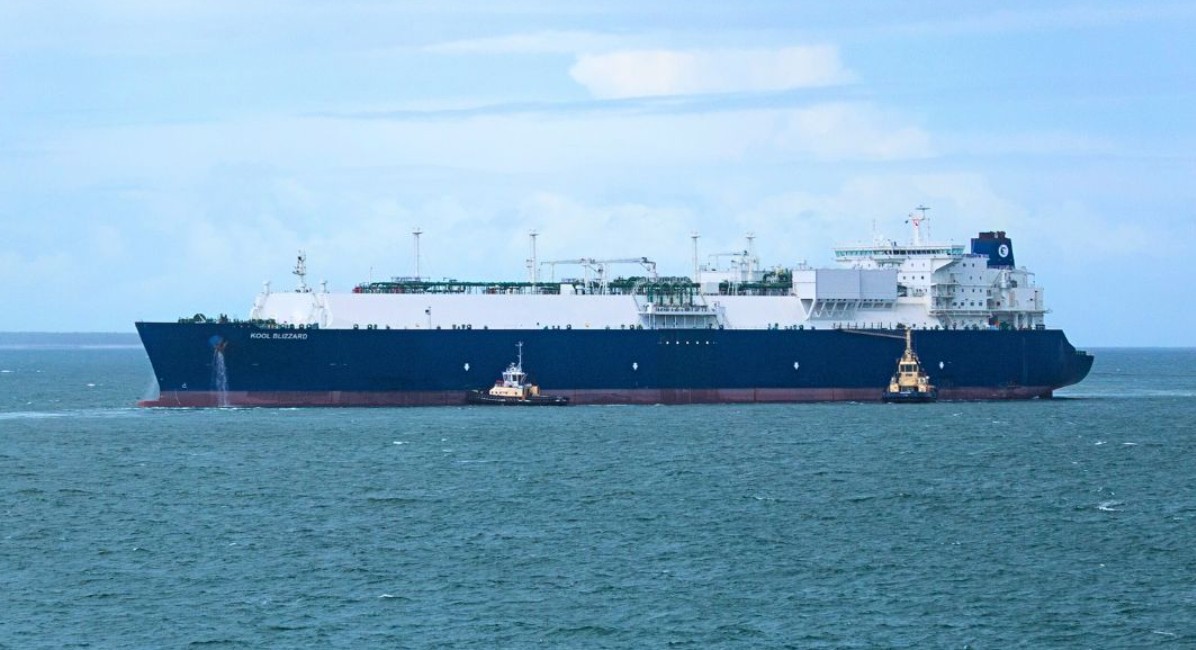
Santos announced the loading of the first LNG cargo in its fourth-quarter report on Thurday.
According to a social media post by the firm, the 160,000-cbm Kool Blizard, owned by Eastern Pacific Shipping’s CoolCo, is loading the first Barossa LNG cargo at the 3.7 mtpa Darwin LNG plant at Wickham Point.
Santos sold this LNG cargo on a delivered ex-ship (DES) basis.
Santos is the operator and has a 50 percent interest in the Barossa gas project, with joint venture partners PRISM Energy International Australia (37.5 percent) and JERA Australia (12.5 percent).
FPSO
The company previously said that the ramp-up of the Barossa project had been delayed due to software issues affecting the safety systems onboard the BW Opal FPSO.
“Santos now has a strong platform for production growth with Barossa’s first LNG cargo currently loading at Darwin. We have taken a very considered approach to the final stages of commissioning to ensure offshore operations achieve a steady state, high level of reliability as quickly as possible once full production is achieved,” Santos CEO Kevin Gallagher said in the fourth-quarter report.
Following two connection failures on the utilities and firewater mains GRE pipework systems, a campaign to strengthen all similar connections across the FPSO was undertaken, which caused delays of approximately two months to our production ramp-up schedule. While this was disappointing our aim is to commission the facilities and to identify and rectify any vulnerabilities to support our objective of achieving a high reliability operation for the long term,” he said.
According to Santos, the BW Opal FPSO continued start-up and commissioning activities while ramping up gas export volumes, which are now at 450 mmscf per day, or around 75 percent of plant capacity.
The FPSO is the production centrepiece of Santos’ Barossa LNG project and will be permanently located in the Barossa gas field approximately 285 kilometres offshore from Darwin in the Northern Territory of Australia.
It will feed the Darwin LNG plant for the next two decades.
The Darwin LNG plant launched operations in 2006. It achieved RFSU in August 2025, following the successful completion of the life extension project for Barossa LNG.
In 2023, the last LNG cargo produced from the Bayu-Undan gas field sailed from the LNG plant in Australia’s Northern Territory.
The final LNG shipment from Bayu-Undan left the Darwin LNG plant on November 11, 2023.
Results
Santos reported sales revenue of $1.23 billion in the fourth quarter, contributing to cumulative revenue of $4.94 billion in 2025.
Fourth-quarter revenue decreased compared to $1.40 billion in the same quarter in 2024, but it rose 9 percent compared to the previous quarter.
Full-year sales revenue decreased 9 percent.
The company reported production of 22.3 mmboe for the fourth quarter, and full-year production of 87.7 mmboe.