
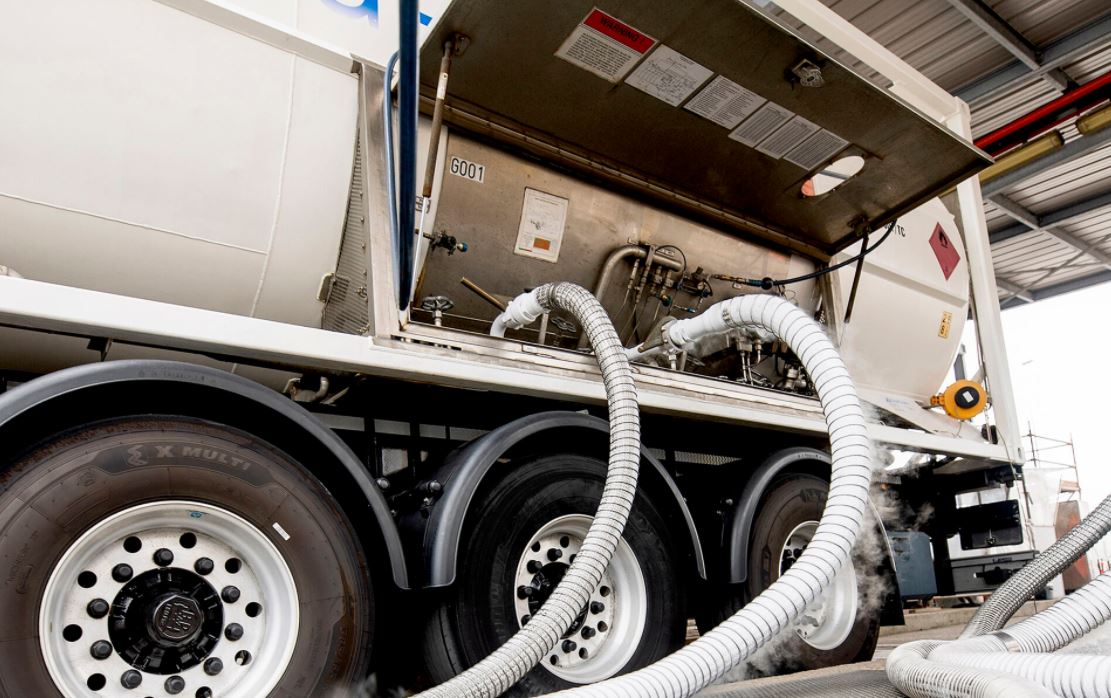
Belgium’s Fluxys said it would build four additional truck loading bays at its Zeebrugge LNG terminal to cater to an increasing demand in the freight transport sector.
The new truck loading bays will go online in 2024, Fluxys said in a statement on Thursday.
With demand for LNG as fuel growing, the existing two truck loading bays at the Zeebrugge terminal will reach their maximum capacity.
“While the number of truck loadings in 2017 was still around 1,450, the utilisation rate for this year is estimated to rise towards 6,000 loadings, approaching the maximum capacity of 8,000,” Fluxys said.
This move follows a call for market interest in truck loading slots held last summer and which showed “strong demand for booking substantially more slots in the future.”
Growth in LNG-powered truck fleet
LNG trailers mainly load at the Zeebrugge terminal to supply fuelling stations servicing LNG-powered trucks.
However, they also supply LNG-powered ships and remote industries without connection to the gas grid.
Another option includes loading LNG containers for onward intermodal transport by train or ship.
“The key demand driver for substantially more truck loading slots at the Zeebrugge LNG terminal is the fast-growing fleet of LNG-powered trucks and the equally strong rise in fuelling stations to service them,” Fluxys said.
Freight transport companies are increasingly switching to LNG-powered trucks in order to stay within the emission standards in their activity.
Over the last five years, the number of LNG fuelling stations in Europe has quadrupled to 400, according to a recent report by Brussels-based association NGVA Europe.
Bio-LNG plans
Besides the new truck loading capacity, Fluxys has additional plans for bio-LNG.
Since last year, the Zeebrugge LNG terminal is the first in Europe to be officially certified to make bio-LNG available, Fluxys claims.
“Bio-LNG is carbon-neutral and opens up the prospect for both freight transport companies and ship owners to take the step towards full decarbonisation,” it said.
Fluxys plans to launch a market consultation this summer with a view to establish a regulated bio-LNG service, it said.
The Zeebrugge terminal currently consists of five tanks with a storage capacity of 566,000 cbm and a regasification capacity of about 6.6 mtpa.
Earlier this year, Fluxys took a final investment decision to almost double the regasification capacity at the LNG terminal following a successful open season. The firm aims to wrap up the new 6 mtpa project as of early 2026.