
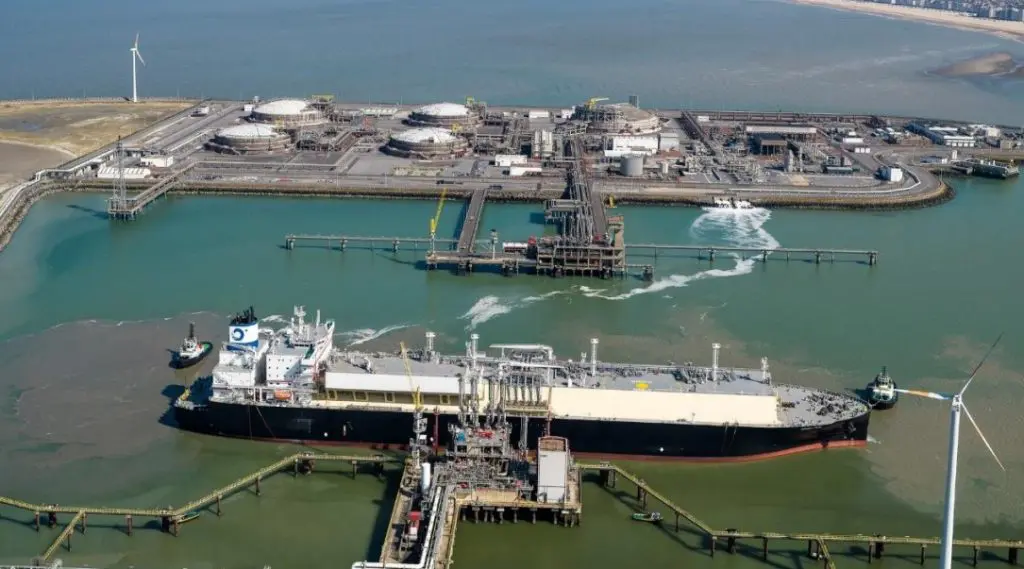
In 2020, Fluxys started offering bio-LNG liquefaction service to Zeebrugge terminal customers, making biofuel accessible to these two sectors.
The company said in its first half-report last week that bio-LNG liquefaction is “entering a second growth phase in 2025, linked to the use of bio-LNG for bunkering in the North Sea.”
Accprdong to Fluxys, this led to a total of 1069 GWh of booked capacity in the first half of 2025, compared to 614 GWh in the first half of 2024.
In addition, a new monthly record of 290 GWh was set in June 2025, the firm said,
“Due to increased demand from the German transport sector, the volume of bio-LNG increased ninefold in 2024 compared to 2023, an increase that is continuing in 2025,” Fluxys noted.
Truck loading
This year, four new truck loading bays entered into service at the LNG import facility located in the port of Zeebrugge.
The LNG import terminal previously had two truck bays with a capacity of about 8,000 slots per year.
However, Fluxys decided in 2021 to build four additional bays.
In the first step, the truck loading capacity has been increased to 14,000 slots. After that, Fluxys aims to offer 20,000 slots.
Fluxys built this new infrastructure as a response to the “sharp increase in demand – especially from the transport sector – for LNG and bio-LNG.”
In the first half of 2025, 22 percent more trucks were loaded compared to the first half of 2024, Fluxys said.
Almost 80 carriers
Fluxys noted in the report that natural gas volumes to Germany and the Netherlands rose significantly in the first half as the geopolitical situation in Ukraine has altered the dynamics of the gas markets and the direction of gas flows.
Border-to-border volumes in the first half of the year were up 20 percent to 160 TWh, while volumes for consumption on the Belgian market were up slightly to 82 TWh (compared to 79.5 TWh in the first half of 2024).
Flows to Germany increased to 98 TWh (compared to 84 TWh in the first half of 2024), while flows to the Netherlands totalled 48 TWh (compared to 36 TWh in the first half of 2024).
With Zeebrugge serving as a crossroads, Fluxys said its Belgian network continues to play its role as an energy hub in North-West Europe.
“Shipping traffic hit an unprecedented high, with nearly 80 ships unloaded at the LNG terminal in Zeebrugge,” the company said.
Moreover, on June 6, flows from the terminal into the Belgian grid set a new record at 716 GWh, equivalent to the output from 30 nuclear units in one day, the firm said.
In August 2024, Fluxys LNG received the 3000th cargo of LNG at its import facility in the port of Zeebrugge.
In operation since 1987, the Zeebrugge LNG terminal mostly receives shipments from Qatar, USA, and Russia.
Due to high demand for LNG, Fluxys is expanding the facility, and it has already increased the terminal’s capacity by adding three new open rack vaporizers.
The capacity has been increased since January 1 last year to 11.3 mtpa (15 bcma).
“The additional sendout capacity (1.3 mtpa / 2 bcma) is scheduled to be available on January 1, 2026,” Fluxys said previously.